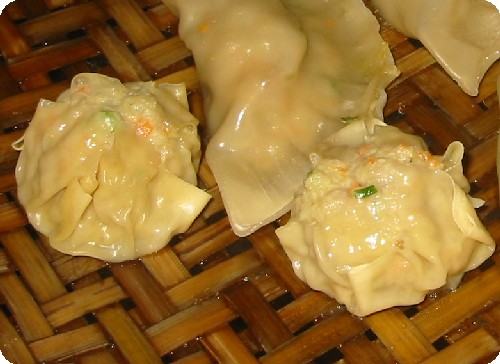
This is a basic recipe that can be modified and can also be used for lumpiang Shanghai.
It is a crowd pleaser and may be served on its own or with rice. It is also steamed, which is more manageable if cooking with children.
Steaming is an excellent method of food preparation since the hot vapour quickly cooks the food while retaining the flavour, colour and nutrients. A metal or bamboo steamer can be utilised though I personally prefer the latter. The vapour permeates the bamboo which gives the food a fine and thorough steaming compared to a metal steamer whose vapour is reduced to large drops of condensation which result in somewhat soggy siomai (but that’s just me, the ever fastidious cook). I wonder though if lining the metal steamer with cheese cloth will give better results. If you do not have a steamer, improvise with a deep frying pan (cuali) and a bamboo strainer (bicse, bitse). You don’t need an airtight cover for this. One can also improvise with a rice cooker, a wire or expanding metal basket which will hold the food to be steamed above the water. The water should already be boiling before the food is placed in the steamer.
Siomai (from siu mai, shao mai, sieu mai) is a dimsum of Chinese origin which is also quite common in the Philippines. One can order different kinds of siomai but the base is usually pork. The ground meat should have some fat otherwise the cooked siomai will be too tough. I tried to experiment on chicken siomai some years back and made the mistake of taking out the skin and fat and it turned out to be tough. Prawns or shrimps can be substituted for part of the pork if desired. For the binder, some use flour or corn starch but I find it to leave a raw taste so I use egg instead (proportion is 1 egg to 1 kg pork). I strongly recommend adding vegetables to give the dimsum some crunch and for nutritional reasons too. If desired ¼ cup of chopped mushrooms or black ear fungus and 1/3 cup fresh or frozen green peas can be added to the recipe below:
Siomai
1 kg ground pork (suggested proportion of fat to lean meat is 1:3)
1/3 cup chopped water chestnuts or jicama (singkamas)
1/3 cup chopped carrots
2 medium or 1 large minced onion(s)
bunch of spring onions or leeks
1 egg
5 tablespoons sesame oil
1 teaspoon freshly ground pepper
1 teaspoon salt
50 pcs. large or 100 pcs. small wanton or siomai wrapper
soy sauce, calamansi (lemon or kumquats), sesame oil and chilli paste (for the sauce)
- Mix all the ingredients for the filling in a bowl. For a smoother consistency, you can hand-chop all the dry ingredients first. Or give them a whirl in the blender then add the wet ingredients.
- Spoon 1 tablespoon of mixture into each wrapper. Fold and seal.
- Meanwhile, boil water and brush steamer with oil.
- When the water gets to a rolling boil, arrange the siomai in the steamer and let stand for 15-20 minutes, longer for larger pieces.
- Serve with soy sauce, calamunding and sesame oil. Chilli past is optional.
Siomai wrappers, also known as wanton or dimsum wrappers, are readily available in groceries and supermarkets but I keep getting requests for a recipe, also for chilli paste.
The common wrappers are just flour and water but I choose to add egg to enrich them a bit, especially if the siomai will be served to children and teenagers.
Siomai Wrapper
1/4 cup water
1 egg
1 tablespoon vegetable or corn oil
1/4 teaspoon salt
1 1/2 cups all-purpose flour
- Beat egg and mix with flour till free of lumps.
- Bring water, cooking oil and salt to a boil, then pour in flour.
- Remove from heat and beat until mixture forms a ball.
- Divide the dough into 1 1/4 -inch balls.
- Roll each ball on a floured board until paper thin. Set aside.
The simplest version of chilli sauce is a combination of chillies, garlic and oil. Combine chopped chillies and finely crushed garlic then simmer in water for around 20 minutes or till most of the liquid has evaporated. Add oil, simmer and stir well.

 The Pilgrim's Pots and Pans
Leave a comment