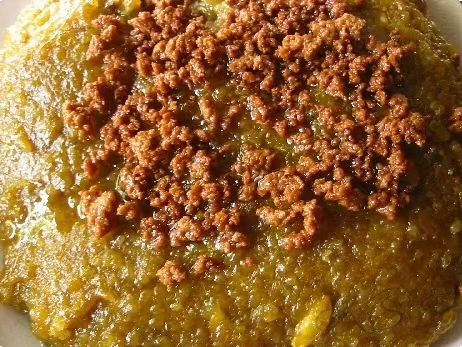
Almost everyone is preparing for the holidays and if one reads food blogs, that means a lot of cooking! Many associate Christmas cooking with baking. Just recently, the food blog community Is My Blog Burning had a cookie swap. I understand that this has become a tradition in many places in the US during the holiday season.
Here in the Philippines, it is also customary to exchange food items during the Christmas season. When I say Christmas season of course, it starts in September, as the cool wind blows down from the north and migratory birds start wintering in our tropical clime. From then on, time swiftly flies past. In December, all sorts of confections and baked goods seem to flood the tables. There was one time I received five boxes of cookies in a span of three hours!
For me however, it’s our native cooking which makes it feel like Christmas. Even if I do not see a single cookie it would still be Christmas-sy if there is suman and calame (calamay or rice pudding). This year, we started cooking a few days before December since we’re joining two events – the Pampanga Day agro-industrial trade fair and a cultural festival in our town. Since the main industry of Santa Rita is agriculture, I’m promoting the produce of our local farmers and small food manufacturers. For our Duman Festival, I have a booth selling traditional ethnic food which is customarily served in Santa Rita during the Christmas season. Although the recipes have been cooked by our family for at least a hundred years, I still persuaded my mother to kitchen-test them to codify the measurements. Below I post a recipe for bico culubasa (squash rice pudding).
Although we normally have this during Holy Week, I also thought of serving it during the festival since it’s a very good representation of some of our town’s harvests namely lacatan or glutinous rice and the culubasa (calabasa or squash). The ingredients for this recipe are easily available anywhere in the world but the procedure can be trying. It’s a long and arduous exercise and needs very strong arms to be cooked properly (Aha! Now I know why I was so good at grappling in judo!). We cook this in a native clay wood-burning stove and I don’t think it can be effectively accomplished otherwise.
Bico Culubasa
1 kg. glutinous rice
8 small coconuts, meat grated
1 medium very ripe squash, sliced into small pieces with skin and seeds
1 kg. light brown sugar (we call it B-X pronounced ba-ekis or washout)
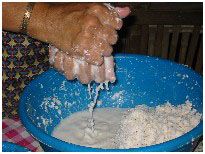
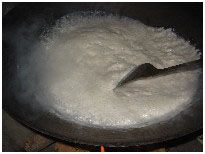
Soak glutinous rice for at least two hours. Extract coconut milk from the ground meat. The first pressing should be separated from the second thinner milk.
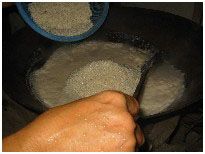
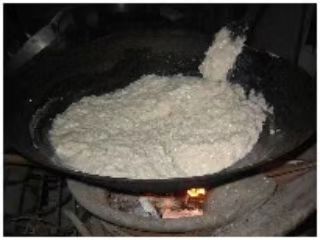
In a large vat, boil the thick coconut milk till the oil becomes apparent but not yet curdling. Add the soaked glutinous rice and stir constantly since rice burns easily.
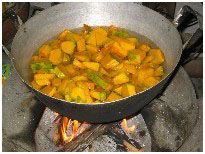

While waiting for the rice to cook, boil the sliced squash in the thin coconut milk till tender. Mix with the rice and “fold” well until the squash has completely macerated, uniting with the rice into a golden hue, then add sugar.
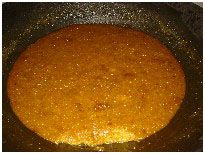

In due time, the rice grains will also be less evident, having been turned into a pastey consistency together with the squash. The mixture is about to be ready when it can be lifted in a single piece without breaking. This is achieved by long hard mixing and folding with live coals underneath the vat.
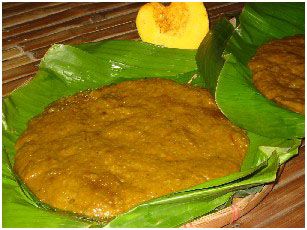
Transfer into an igu (bilao or bamboo tray) lined with bamboo leaves while still warm. Enjoy with some salabat or ginger brew and put up your feet. You deserve it after at least four hours of back-breaking work in front of a stove.


 The Pilgrim's Pots and Pans
Leave a comment