Is My Blog Burning? is the brainchild of Alberto at Il Forno and it has really caught on as bloggers the world over eagerly await and prepare for the monthly event. Today would be the eleventh edition and we anticipate the sharing of recipes around the theme ‘beans’. Cathy at my little kitchen is hosting it this time. I should also mention that this is the first time I’m taking part in the events though I’ve been listed in the IMBB portal since November of last year.
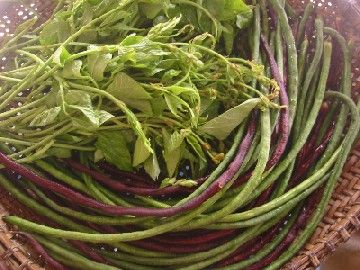
When Cathy announced this month’s theme, I was both relieved that I didn’t lack for kinds of beans and recipes yet worried that I may not be able to decide from among the choices. There is a whole wide world of beans and a line in the Tagalog folk song ‘Bahay Kubo’ (My Nipa Hut) enumerates the most common Philippine species – sigarilyas… sitaw, bataw, patani, munggo… (winged beans … the ones in the picture above, hyacinth beans, civet or lima beans, mung beans). In fact, on the PC at that very moment I had pictures of at least two recipes with sitaw as an ingredient. Which one would it be?
Sometime back, I told Renee on Shiokadelicious! that I’ll be posting a recipe for pinakbet, a mainly vegetable dish combining beans, squash, bitter gourd, okra and aubergines (eggplants). However, in pinakbet the beans aren’t the centre of attention. Hmmm… Cathy said they didn’t necessarily have to be the dominant ingredient but I wanted to focus on them. And so I decided that the one that was predominantly beans shall be cooked. Finding out the common English name of the beans was actually a story I’ve been meaning to tell and now it is told (see the previous entry). But first, the IMBB recipe.
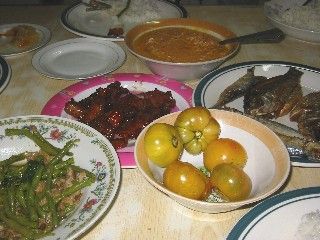
A few days before Christmas, I unexpectedly had dinner at a family friend’s place. Although we had several dishes, my attention was drawn to the tipé câmangyáng. This is a traditional dish in our town which I have not seen in the city. I also hadn’t eaten it for at least ten years. Neither the method of cooking nor the ingredients are special yet the taste, if properly prepared, embodies simple satisfaction. It is also an efficient dish since it makes use of different parts of the plant without killing it. Nutritionally, one derives protein and fibre from the beans and vitamins from the leaves. The câmangyáng are the beans and the vine from which the beans are derived. I still haven’t figured out what tipé (tee-peh) means though.
Now, in the Philippines, we use a lot of greens for our cooking such as those of chilli peppers, bitter gourd, squash, sweet potato, tamarind, beans and almost any edible plant. In fact, we have a predilection for using very young leaves for cooking or for salads that there are specific terms for them – lángguc, talbós, pútat, túlud, etc. – depending on the plant. It would be wonderful to find out if this is also the case for the rest of the world. The recipe below calls for the very tender leaves of the bean plant. It is also highly recommended to use fresh shrimp extract to make it more flavourful. I deliberately cooked on the clay wood-burning stove and took out our ancient yet serviceable cuali (carajay in Tagalog) or cast-iron wok-shaped pan and used the wood and coconut shell sandok (cooking spoon) to imbue this entry with a sense of tradition. What I said in the last sentence is however not necessary if you decide to cook this.

Tipé Câmangyáng
100 g. lángguc câmangyáng (only the tender leaves, no stem)
400 g. bungang câmangyáng (sitaw, stringbeans, yard-long beans, cowpea, your choice of name, cut into bite-sized length)
100 g. paro (shrimps, shelled)
100 g. babi (pork, sliced into thin strips)
60 g. bauang (crushed garlic, less if using the native variety)
80 g. sibuyas (thinly sliced onions)
300 ml. sabo paro (shrimp extract)
1 tbsp. cooking oil
about a half cup of water
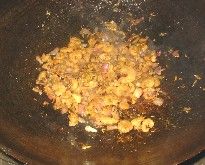
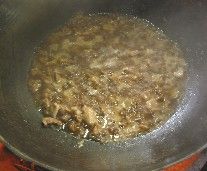
In a wok or deep pan, heat oil then lightly brown the garlic and then add the onions. As soon as the onions become translucent, put in the shrimps and ‘toast’ for around 5 minutes, making sure they do not burn. Add the pork and also ‘toast’ for 5 minutes or till tender. Pour the shrimp extract and let boil until reduced to a pasty consistency (the extract, not the shrimps and pork). By this time the pork should already be very tender.


Now the beans should be ready to jump into the pan (jumping non-jelly beans!). Stir-toss them for around a minute, add half of the water and cover the wok or pan. Let it simmer for a while until the beans are almost cooked. Test the beans for doneness. As soon as they cease to taste raw, yet still a bit undercooked, add the leaves and the rest of the water then let the wok or pan simmer again. Stir upon simmering and turn off heat but cover the pan. Let stand for 5-10 minutes. Serve with rice.
Cultural notes:
- The foreign-to-English words I’m using in this entry are Capampangan except for those in the song ‘Bahay Kubo’ which are Tagalog. Capampangan and Tagalog are linguistically distinct Philippine languages.
- From a very recent conversation, a friend – who is Tagalog – said that she has never heard of the bean leaves being cooked. Now I wonder if this is unique to our province. Perhaps I should survey the nearby provinces.


 The Pilgrim's Pots and Pans
Leave a comment