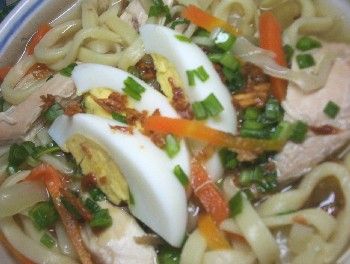
This was another IMBB of many options. So many noodle dishes, so little time!
For this month’s theme, Amy chose Use Your Noodle to make us think and improvise around a food article beloved the world over. I am already looking forward to reading the other entries during the round-up.
It is still cold even in this tropical country. There are nights when one wishes for a nice steaming bowl of something, anything to keep down the chill. Oh the possibilities one can think of! But then a hearty noodle soup was right up there on top of the list!
Although it wasn’t easy choosing my entry for the month, I knew I wanted something I haven’t had for sometime like mami (pronounced ‘mah-mee’). This is a noodle dish innovated by a migrant Chinese entrepreneur who started out very humbly in the late 1900s then was so successful he was able to build up a chain of eateries in Manila. In fact, the word mami is a combination of his name, Ma Mon Luk and the word for noodle – mi. Kirk over at mmm-yoso!!! has even had an encounter with his descendants in the US and writes about it in Asian Noodles – I Want My Mami. What Ma Mon Luk pioneered has since then become very popular and can now be found almost everywhere – from respectable restaurants, makeshift eateries and even as street food!
Mami is one type of the noodle soup found in many Asian countries. It has many counterparts both in mainland Asia and in archipelagic Southeast Asia, each one suited to the population’s palate and the availability of ingredients. In the Philippines, the usual mami uses fresh round noodles, has a light broth with meat – chicken, pork and/or beef – and vegetables. Sometimes wontons are also included.
For my version, I used chicken since I had stock reserved from a chicken-macaroni salad that I made earlier. I also used miki (pronounced ‘mee-kee’), a flat, fresh noodle made from flour, soda, salt and lard, according to the package. Miki is usually cooked another way but I thought i’d cook it mami-style.
Although noodles were introduced in the Philippines by the Chinese, Filipinos have since then adapted them to their taste. What I find as a very Filipino twist is to top mami with a combination of boiled egg slices, spring onions, fried garlic and according to preference, sometimes a squirt of calamansi. The ground black pepper and fish sauce is of course a given.
Mami-Style Miki
2 small chicken breasts
2 litres chicken and vegetable stock
1 small cabbage
3 medium carrots
1 large stalk celery
1 large onion
250 g fresh noodles (miki)
5-10 whole peppercorns (approx.)
3 pcs. cloves
2 laurel leaves (bay leaf)
1 tbsp. oregano
salt to taste
Toppings and condiments
3 hard-boiled eggs, sliced into 6 sections each
3 heads crushed fried garlic (approx)
2 stalks spring onion, thinly sliced or chopped
calamansi slices
ground black pepper
fish sauce
Cooking will be a bit faster if you have chicken or vegetable stock but it is not necessary. Even it is available, the chicken breasts would still have to be parboiled and if it is not, then the water used to boil the chicken can be used as stock.
- Chop one carrot and a quarter of the cabbage. Julienne the rest of the carrots and thinly slice the cabbage.
- In a pot, cover chicken in stock or plain water. Season with half a teaspoon of salt, whole peppercorns, 3 cloves, laurel and oregano.
- Add chopped carrots and cabbage. Let it boil till chicken is tender.
- Take out chicken so as not to overcook.
- Debone and return bones to the stock. Keep it on a low simmer till serving time.
- In a separate pot, boil around a litre of water.
- Drop the fresh noodles and let it come to a rolling boil.
- Take out the noodles as soon as tender but still with some resistance or al dente. Wash the noodles in cold or tap water. Drain.
- In the same pot used to cook the noodles, pour in one or two servings worth of the chicken and vegetable broth, half a cup of the julienned carrots and thinly sliced cabbage.
- Boil for 2-3 minutes then add the noodles and pieces of chicken. Pour into bowls as soon as it boils.
- Garnish with the toppings and season with the condiments as desired.
A bowl of this mami and I was full!
Thank you Amy for hosting this month’s IMBB!
Update: The round-up for IMBB 22 is now online.

 The Pilgrim's Pots and Pans
Leave a comment