In this fast-changing world, we are in danger of losing some practices we take for granted. Everything changes but to forget some essential details of a culture such as food traditions is alarming. Even here in the Pampanga, only a few people remember our old recipes and I believe that to lose them is banishing a part of our Capampangan identity to oblivion.
One of the reasons for this loss is how we do not take time to discuss and transmit them to the next generation. If I hadn’t started the habit of taking notes on our hometown food, I wouldn’t have been disabused of some misconceptions. Take for example something as plain as salabat. I have become accustomed to salabat as a pot of boiling water, some ginger and sugar and I assumed that this was the standard. They even sell it bottled and powdered in groceries nowadays and that has become the norm. It is all very convenient but the real thing for me is when one can taste bits of fresh ginger with every gulp, as I remember from days not too long ago.
A good part of my childhood memories are of Lola brewing salabat for us. Perfect for cold weather, as ginger warms the body, it is also perfect for hot days as there is no better way to release heat than by sweating. We had to take the brew very strong if we had colds and if we were singing or reciting poems during school programmes. I wonder how many generations of children are made to do the same.
Lola’s salabat always had camote (sweet potato, Ipomea batatas). I assumed she put it into the brew for us children to have something to munch on or perhaps to neutralise the too-spicy taste of ginger. But recently, I found out that I assumed wrong! Camote is not an add-on but an essential ingredient of salabat! Sago (tiny tapioca pearls) can be added too. This was an interesting discovery which needed a little more research. Was it just our family or did people from our town have salabat the same way?
So, while taking pictures of old farm implements in the barrio where my Lola was born, I asked our neighbours how they had their concoction. Not only do they have camote and sago but a dollop of carabao’s milk as well, just before drinking! Really?! When I told my mother about it, she dismissed it as normal. Just like how some cultures take cream with their tea, she said.
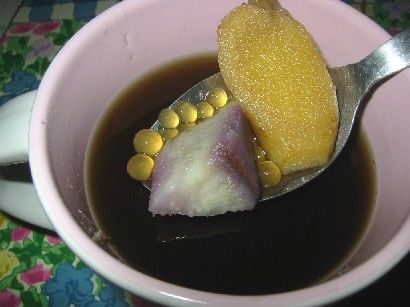
And so I tried to re-create the authentic salabat. In the picture above, you may notice the brew to be quite dark as pinocha (panutsa in Tagalog or solidified raw sugar) was used.
That moment of rediscovering Lola’s salabat was the turning point towards my desire to learn more about our traditional food. I didn’t want to just take down notes but begun to starting to ask probing questions as well. The time that I have spent exploring our culinary traditions has been extremely enriching for me. It has not only expanded my understanding of our food but has deepened my appreciation of our culture in general. Truly, it is a journey worth undertaking – and what exciting adventures it brings!
Salabat
Handful of ginger, peeled, sliced and roughly crushed
4-6 cups cold water
2 medium sweet potatoes, peeled and sliced
½ cup cooked sago pearls
pinocha to taste, substitute brown sugar if not available
In a non-corrosive pot, soak the ginger in half of the water for around 15 minutes then boil gently for 10 minutes. Add the pinocha or brown sugar to taste and boil for 5 minutes. Put in the camote and boil till almost done then add the sago. Simmer gently for around a minute then steep for a while longer before serving.

 The Pilgrim's Pots and Pans
Leave a comment