
Would anyone happen to know a Mexican food blogger I can contact? Why? Here’s another long-winded explanation and my way of asking for suggestions.
I don’t intend to make it an event in the tradition of the Is My Blog Burning? spin-offs but the more I think about it, the more I’m convinced that IMBB? is the perfect venue for this project, especially with the theme on the portal masthead “recipes of the people, by the people and for the people”.
It is interesting how we relate to each other through food. Sometimes a few ingredients are universally familiar and at times some are quite exotic to many. There are times when we use different names for the same ingredients or use the same name for different ones. I’ve noticed this when I started reading food blogs, even before I had a first-hand experience.
Then one day a college friend, who is now in the US, and I were talking about our lowly singkamas which we take for granted in the Philippines. All along I thought this was an indigenous root crop since it can be found all over the country and is eaten in many ways – as a snack dipped in shrimp paste, vinegar or salt, sautéed as a vegetable, pickled, fried and included in spring rolls. When Catsudon pointed out that our singkamas looks and tastes exactly like the Mexican jicama, I realised that it could be a migrant food. Singkamas doesn’t sound much different from jicama and in Pampanga, whose food culture is heavily Hispanised, it is even sicamas. Perhaps it came to the country through the galleons. After all, Spain ruled us through Mexico for 250 years. Obviously, neither of us read any of Doreen Fernandez’ Filipino food anthropology books for when I finally got Tikim, she does mention it as a Mexican root crop.
On another plane, I have always thought that food should always be considered against the context from which it developed, such as culture and natural environment. Since this is a very broad canvass, so to speak, I had to limit my scope to the physical environment, at least for the meantime. Much of our respecitve cultures is discussed by our many blogs anyway. I am also coming from the experience of having taught many freshmen university students who grew up in the cities and seemed alienated from their surroundings. In one of our on-site field activities, one of them, a very macho, strong silent type pranced around singing “The hills are alive with the sound of music” and when he saw me and his classmates astounded, he explained that it was his first time to be in ‘touching distance’ with a mountain and not just passing by in a car. The whole experience overwhelmed him. In the same way, many children and perhaps even adults nowadays only know that the produce they cook and eat comes from the marketplace or even just supermarket shelves. The affinity with nature is lost since they have not seen how a plant grows and bears fruit. There is no longer the anxiety felt when a vine seems to be wilting or a bush infested with aphids.
So, I broached the subject to Ronald, our IMBB? administrator. He was receptive to the idea even when I said I still had to think of the format. Now that I have the basic outline, something like a working paper, let me have your thoughts. Let’s call this a draft which will be revised time and again. I’m posting the sample format below.
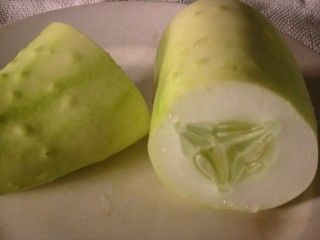
Basic:
Common English name: Cucumber
and then in as many languages as possible: Pipino (Tagalog and Capampangan from Sp.), pepino (Spanish)
Scientific name: Cucumis sativus L.
Type of plant: vine
Parts of the plant used: fruit
Uses (food, medicinal, whatever): fruit as vegetable, cooked and uncooked
Description: yellowish to dark green tubular fruit (expand description as we go on)
Origin (if possible): East Indies (?)
Currently cultivated: temperate regions, tropical areas
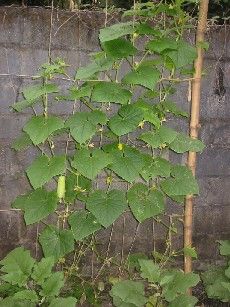
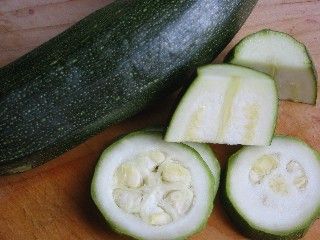
I am trying to build up my photo library of how the plants start out as seedlings, grow into mature plants, their flowers and fruits (like those in the Stringbeans-Long Beans entry). I have also taken pictures of fruits, both whole and some cross-sections to show their internal structure plus their seeds, like of the courgette/zucchini below. My taxonomic botany knowledge is nil yet someone who is capable may just drop by and give us a layperson’s explanation.
The idea is, someone introduces a fruit, vegetable, spice, or whatever ingredient and others can add on to that, for example, by saying that is called such-and-such where I am and it comes in these varieties or used in these recipes. Even readers who don’t have blogs can contribute with pictures and descriptions. The initial entry may be posted in the respective contributor’s blog, perhaps after revising the article based on the comments, it shall have a mirror site on the IMBB? Portal. Being a resource, I think this is best because some blogs go offline or they delete their posts so I really think it best to centralise the entries. I welcome suggestions on how to make this more efficient.
As to the reason for the search for a Mexican food blogger, I wish to collaborate on a blog project that traces the pathways of foodstuff transported through the Manila-Acapulco galleon trade. There are a lot of Mexican plants which have been indigenised in the Philippines – to the point of them seeming native – and I wonder if there is such reciprocity.

 The Pilgrim's Pots and Pans
Leave a comment