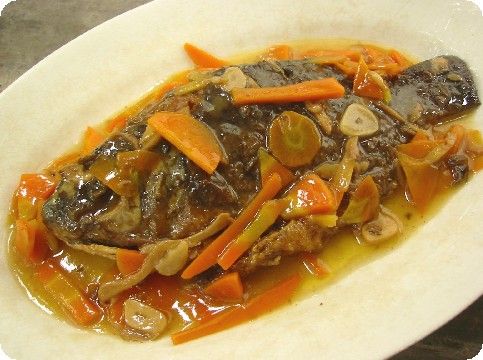
Underneath the carrot and capsicum strips is a tilapia (Oreochromis niloticus) navigating its way towards the list of IMBB entries. This month’s host of the very successful meme, courtesy of Alberto’s original idea, is Ladygoat at Foodgoat… with the theme Orange you hungry?
Since busy days are upon us (my blog friends would have noticed by now how I didn’t pester them to join this month’s IMBB and I’ve neglected to bloghop ) and summer brings days which make spending time before a stove oppressive, I opted for an easy but classic recipe. This is one of several versions of escabeche, a dish common to many Hispanised regions in the Philippines.
A cursory glance at Iberian and Latin American escabeche recipes show that it is originally a sour, spicy, a little sweet and salty pickled marinade which makes use of chillies and other spices. Epicurious has this entry:
“Escabeche originated in Spain, where it means “pickled”; it’s a spicy cold marinade that was created as a way of preserving food. Escabeche followed Spanish culture around the world, with scabetche in North Africa, escabecio in Italy and escoveitch in Jamaica. The traditional recipe is made with fish fillets or small fish (like anchovies or sardines) that have been deep-fried or poached, then marinated for 24 hours. Escabeche is also used in preparations for vegetables, salads, poultry and eats.”
Ceviche is also derived from this word.
Brought to the Philippines, where water bodies teem with life all year round (or at least they did during the Spanish occupation) and the preferred mode of preservation is salting and drying, escabeche seems to have become more of a sauce rather than a preservative, not unlike Oriental sweet & sour recipes. The latter however, uses more ginger. In practice though, they are used in interchangeably. But in our family, it is always sweet & sour meat, escabeche is reserved only for fish.
I grew up on festive-looking escabeche due to its colourful presentation – orange from the carrots and red from the capsicum. For this recipe however, I decided to use yellowish-orange capsicum to fit perfectly with the theme. Observant readers of this blog will by now realise how I tend to take IMBB themes seriously and literally. It’s just more fun that way, tee hee!
The recipe below can be adapted to use any type of fish, whether saltwater, freshwater, large, small, firm or soft, whole or filleted. The proportions given are just for the tilapia that I used. They can also be modified according to taste. Enjoy!
Fish Escabeche
1 medium-large fish, cleaned and lightly salted
8 large cloves of garlic, 4 cloves sliced cross-wise and 4 finely crushed
an inch of ginger root, julienned
1 small carrot, julienned or thinly sliced
1 medium capsicum, julienned
3-5 tablespoons vinegar (approx.)
1/2 to 1 teaspoon salt
1-2 tablespoons sugar
1/2 teaspoon flour or cornstarch (optional)
water
cooking oil
Lightly fry the fish over medium-high heat for 3-5 minutes such that the outside is crispy and the inside still tender, then set aside. Firm species can be poached instead. Make sure they are not thoroughly cooked otherwise the flesh will fall off later.
In a separate pan, heat a teaspoon of oil then fry the crushed garlic. When almost golden brown, add the sliced garlic and ginger. Stir-fry for around two (2) minutes, add the capsicum and then the carrots*. Pour in half the vinegar, the sugar and salt then let simmer. If using cornstarch or flour, dissolve this into half of the vinegar, then pour into the simmering mixture. Add water to reach desired consistency and lower fire.
Place the fish into the mixture then simmer for another 3-5 minutes to let it absorb some of the flavour.
* If you like the carrots a bit crunchy, add them to the sauce just before the fish.
Thank you, Ladygoat for hosting this month’s IMBB! Keep those Sesame Street cuties on your posts.
Update: The round-up of orange food is here.

 The Pilgrim's Pots and Pans
Leave a comment