Overseas Filipino Workers (OFWs) are hardly a new phenomenon. Historical documents note that in 1600 Filipinos arrived in California, way before it was part of the United States. They were among the first agricultural workers or field hands in the mission areas. Today, like their contemporaries of centuries ago, most OFWs – whether manual labourers or salaried professionals – are well-liked by their employers because they are conscientious workers who will try to learn new skills to cope or just to be better at their jobs.
This versatility is also found in adapting to different tastes in food. Although there is a propensity for sweet-salty-sour dishes and to always look for rice, the Filipino palate can adapt well to any prevailing culinary conditions be it sushi, hamburgers, shawarma, sauerkraut or whatever is available. With stable work difficult to come by in the Philippines, it is also not rare to find many Filipinos of different vocations to transform into cooks in many ships and restaurants abroad, most especially in the Middle East. The father of a close friend was originally a skilled carpenter/house painter in the Philippines but became head cook in one of the Emirates in the 1980s. I have also heard of similar situations before. It is perhaps only now that the situation has changed since the food industry has become more specialised with culinary schools being established in most major cities worldwide.
Aside from being flexible, it is perhaps the Filipino’s innate sensitivity which enables him/her to adapt and recreate what he/she finds in other cultures. It’s the same thing in music (and let’s not even start on bootleg merchandise), with bands and choral groups mimicking the original artists almost down to how they breathe. This chameleon-like quality is perhaps one of the after effects of living under the edict “comply or die” for centuries.
Today’s post is my own contribution to the Filipino art of adaptation and replication. This is another version of red sauce for pasta, very similar to the others which I have posted sometime back. Aside from preferring red over white sauces, I also keep on trying out new versions as I haven’t yet exhausted my memory of the similar yet very different sauces which I promised myself to replicate. I also haven’t started on homemade gnocchi but that’s another story.
This pasta sauce is very similar to what I ate at the FAO rooftop cafeteria and which I remember to have been intensely flavourful. I don’t know if it was due to the freshness of the ingredients or due to the spectacular view as I ate. After all, dining on the terrace afforded one a postcard-like scenery with the Baths of Caracalla to the right and the Coliseum, the Palatine Hill and Circo Massimo towards the front-left side. I should stop this, I’m getting Rome-sick again.
Perhaps I’ve learnt more about Italian cooking by lingering in that cafeteria, the trattorias and ristorantes than from cookbooks and magazines (as if I buy any, hehehe!). I realised I could learn by smell alone when I was given a seat near the kitchen during a busy evening. I was reading a paper but I could tell the sequence of ingredients being added to the pot. It dawned on me then that in Italian cooking, the onions preceded garlic while in Filipino cooking we saute (gisa) with garlic first then onions second.
By the way, it occurred to me a few weeks ago that one principle that perhaps applies to both cultures, among others, is the use of garlic as a preservative. Ms. T who’s the daughter of an old-time Santa Rita public market food-seller said her mother always instructed them to use a lot of garlic for food and sauces to be mixed with pancit (noodles). This is to prevent spoilage – proven in days prior to refrigerators. By extension, Ms. T has been doing the same thing for spaghetti sauce. Aha! Garlic, after all has astringent and anti-bacterial properties. I wonder what Italian nonnas would say to that.

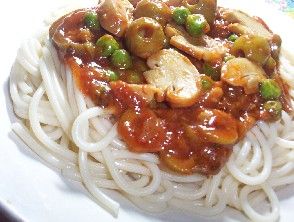
I used diris (dilis in Tagalog, dried anchovies – one among several Philippine species) for the recipe below. See Marketman’s related post on this type of fish. Spaghettoni are large pasta noodles – spaghettini is the smaller variety. In the Philippines, Barilla is the only one which carries it. I used this kind of pasta because the sauce is chunky. Any type of pasta will do but I realise penne pasta (quills) may be better. This is my own concoction of what I remember eating but gave it an Italian name for the sake of hmmm… whimsy!
Spaghettoni dell’acciuga e della melanzana
3 medium long aubergine (eggplants)
1/3 cup frozen green peas
1 can button mushrooms (approx. 200 g. dry weight – fresh will do as well)
1 can green olives (approx. 200 g. dry weight), thinly sliced cross-wise
5 medium-large ripe tomatoes (approx.)
750 ml pureed tomatoes or tomato sauce
heaping handful dried anchovies (diris or dilis)
4-5 teaspoons pesto
half cup garlic, finely crushed
3 medium to large onions
salt to taste
2 tablespoons olive oil
Soak the anchovies for an hour in a bowl of warm water, mash well then set aside. Some would prefer to remove the heads but I’m an ardent fish head eater (don’t look Nancy!).
Heat oil in a pot then fry the onions till about to caramelise then add the garlic and fry till nearly sticking to the pan. Add the tomatoes and a pinch of salt (just a little bit to hasten the extraction of juices – anchovies and olives are also salty), simmer till very soft.
Pour the mashed anchovies into the pot, stir into the mixture well and simmer till reduced to half the volume. Add the aubergine, simmer for two minutes then the pureed tomatoes. I like the aubergine to be very soft, almost creamy and being part of the base of my pasta sauce. If you prefer it otherwise, add to the mixture after the pureed tomato.
Simmer the mixture for around 30 minutes but watch that the pot doesn’t burn. Add approximately 1/4 cup of water every 10-15 minutes if it’s too dry. Add the mushrooms and green peas, simmer for two minutes, then the olives. Simmer for another five minutes then spoon in the pesto. Turn off heat then cover and let stand for at least half an hour to let the flavours meld.
Meanwhile, cook the pasta according to package instructions. The sauce is good for a kilogram of packaged spaghettoni.
To serve, place the desired amount of pasta on a plate then mix a small amount of pesto, making sure the olive oil coats the spaghettoni (or whatever shape). Spoon the sauce on top. For pasta sauces with fish, I omit the cheese but for others, eat according to personal preference.

 The Pilgrim's Pots and Pans
Leave a comment