After a short deliberation, my co-host Stef and I decided to post the round-up for the launching of Lasang Pinoy this evening since we’re still receiving entries. In the meantime, I’ll post something which I would give Ninoy if he were alive today.
After his assassination in 1983, numerous articles on Ninoy came out in both the government-controlled and the underground press. Many of these articles tackled his private persona – the son, husband and father who happened to have big dreams yet remained down-to-earth. A feature article I still remember vividly is about Ninoy and the food that he liked. Since he was from Concepcion, Tarlac which is ethnically Kapampangan, he ate like his forefathers did before him.
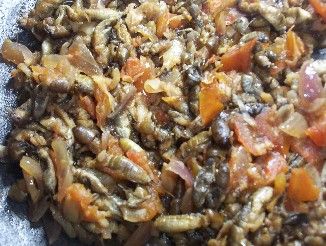
Aside from the article I read, Atching Cora also confirmed that one of the delicacies enjoyed by Kapampangans and which was known as Ninoy’s favourite is a dish of plump mole crickets (Gryllotalpa orientalis Burmeister). These are called camaru (also spelt ‘kamaru’), which are burrowing insects found in soft ground such as rice paddies.
Until very recently, I didn’t realise that our beloved camaru is considered a minor pest (very, very minor, mind you) by rice farmers. I come from an agricultural community where even the lands behind the houses in the town proper are ricefields yet I’ve never heard the camaru was a troublesome creature. Could it be that they are friendlier in our place? Or perhaps Capampangans eat them before they can cause any trouble such that they are already considered rare in many towns nowadays. Couple that with shrinking farmlands and you have succeeding generations of Capampangans who have not eaten, sometimes not even seen what a camaru looks like.
It is interesting to find out how other regions in the archipelago eat other insects but not the camaru. Much more interesting however, is to find out how we first considered them as food. Eating this insect may have started out during very lean times but it is now a highly-valued foodstuff. However, recent studies say insects were probably the first fauna eaten by humans since they were more accessible than bigger and fiercer animals. That makes sense, doesn’t it?
The International Rice Research Institute describes the adult mole cricket to be “brownish and very plump. It measures 25-40 mm long. It has short antennae and its folded wings do not cover the entire length of the abdomen. The enlarged front legs, which are modified for digging, have strong teeth-like structures.” The adult camaru is what is preferred. Those that are smaller, called dumalaga can be eaten but considered inferior because they do not have the desired fatty deposits. In preparing to cook the camaru, the antennae (sometimes called sagu or horns), wings and legs are broken off after lightly simmering in vinegar, salt and spices adobo-style. Personally, the only thing I dread about eating camaru is that I have to endure dressing them one by one before they can be fully cooked to be enjoyed.
We have two well-known recipes for mole crickets and both require that are pre-cooked and dressed. They can then be either stir-fried (sanglé) in very little oil until they are toasted and crispy or sautéed in garlic, onions and tomatoes. Whichever recipe is used, the camaru is always sought after.
I have eaten camaru for as long as I can remember. A mouthful brings a burst of flavour – similar to a rich nutty taste but much more than that. Some non-Capampangan friends I’ve introduced this to were initially taken back when they realised there were insects on the plate but once having tasted just two or three of them, they’ve never looked back. In fact, they outdo me in craving for these tasty bits every so often. Today, instead of just being eaten in the fields, the camaru is much-requested and served in many Capampangan restaurants and home celebrations. I consider it a great leveler since the rich and poor enjoy it both as daily ‘peasant’ fare and as gourmet food.
Mangan ta na!


 The Pilgrim's Pots and Pans
Leave a comment