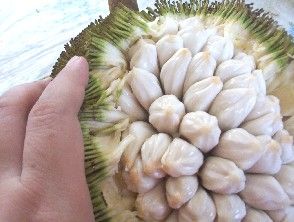
Normally, it takes me the longest time before posting. But today, I am so excited that I just have to. No obsessive-compulsive researching, no editing, no carefully-taken picture – and sorry I can’t do much better – the other fruit-lovers at home got to it before I found the camera. I just have to show the fruit treasure of the month – the marang!
My aunt just came back from a workshop in Davao and as soon as she alighted from the van, I detected a sweet-pungent odour often associated with planes coming in from that southern province. I knew she wasn’t bringing any durian otherwise the scent would have been stronger. When I found out it was marang (Artocarpus odoratissimus), I couldn’t wait to have my hands on the fruit.
Well, I suppose not a few would ask what’s so special about quite an ordinary-looking fruit. Perhaps it does look like its relatives, yangca (langka or jakfruit – A. heterophyllus syn. A. integrifolius), camansi (breadfruit – A. altilis) and rimas (seedless breadfruit – A. communis) but I can say it is a fruit with a character of its own. In the few times I have to choose, I’ll jump for the marang anytime, like this evening, when I apologetically snubbed the mangosteen, the lanzones and the rambutan though I also have an intense love for these fruits.
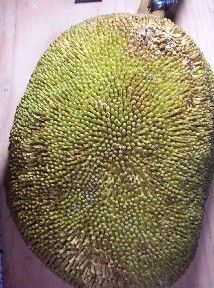
My first encounter with this exotic fruit was in a retreat house in Malaybalay, Bukidnon (Mindanao, southern Philippines). The priests had a few marang trees in the garden and since they were in season, they gave me as much as I wanted. Over lunch, someone even plied my plate with the sweet mass before I could say “yes please”.
Since then, I’ve always had a wonderful love affair with the fruit, albeit on-and-off since I can only have it if I go to Mindanao or if someone flies in laden with precious cargo. Then again, perhaps absence does make the heart grow fonder.
Originally from Borneo and some southern Philippine islands, the fruit is now cultivated all over Southeast Asia. Why wouldn’t it be, after discovering the wonder of marang? It is less hardy than jakfruit and breadfruit but its aroma and flesh sweeter without the rubbery taste.
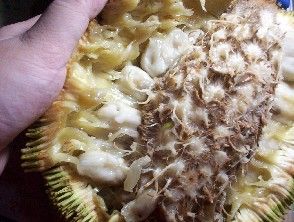
There are two ways of opening the fruit. One is by slicing the rind around its middle and gently pulling the halves apart. The other way is to hold the stalk and peel back the skin like a banana. Once the fruit is opened, it has to be consumed within two to three hours, since the flesh discolours quickly and its flavour turns stale.
Around the core are small globules of white flesh containing brownish seeds (see first picture for the flesh and the second for the pineapple-like core). Now for the taste – the first mouthful awakens the tastebuds to a burst of flavour that is vaguely reminiscent of ripe guavas which fade on to mirinda or passion fruit. That’s just an approximation, of course. The flesh is meltingly sweet but not cloying.
Writing all that makes me hungry and I don’t think I don’t see any marang in the horizon. Hmmm… I wonder if the anunas trees have fruits at the moment.
————————–
Data source: Department of Agriculture. 1995. PHILIPPINES: Country Report to the FAO Technical Conference on Genetic Resources (Leipzig, 1996). Quezon City, Philippines.

 The Pilgrim's Pots and Pans
Leave a comment