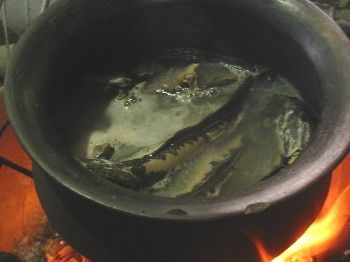
Today we post our entries for the second edition of Lasang Pinoy, the Filipino food blogging event. Our month’s host is Celia Kusinera at English Patis with the theme Cooking Up a Storm! It’s a very fitting topic since normally, September is towards the end of the monsoon season. With drastic climatic shifts however, it seems like typhoons are now intermittent occurences, unlike in recent years when we were able to distinguish a period when they were most frequent.
Time was when the opening of classes coincided with the rainy season. A few weeks into the school year, chances are classes would be called off due to typhoons. These storms would range from mild to very strong, from Signal No. 1-3, before Signal No. 4 was added to the system very recently.
I loved the onset of the rainy season. Soon the stream beside our house would be flowing more rapidly and we’d float our paper boats. Rains also meant playing and taking a bath in the rain, watching the mamadúas on the bridge overlooking the stream near our house. A padúas is a short bamboo fishing pole, mamadúas is both the verb, act of fishing, and the noun the person(s) fishing.
Strong rains and typhoons would be announced by my grandmother who took her cue from the call of the kingfisher flying overhead. She would say inclement weather was brewing in the ocean, the bird was letting us know and we should prepare for the coming storm. True enough in two days or so, the rains would fall like buckets. Indeed, my grandmother must be of the last generation who knew how to listen to the whispers of the natural world and accurately interpret them. Nowadays, we have advanced technology and websites like Typhoon2000.com to predict stormy weather but they all become useless in the event of major power interruptions.
I remember monsoon season to also coincide with days without electricity. In the event of a very strong typhoon, we would stock up on candles and kerosene for the paritan lamps. In the dark of night, as the rain pounds the roof and winds howl, my grandmother would tell us stories from Kapampangan folklore, the Bible, days before the war which she called Normal Time or Peace Time, from her childhood with her brothers and sisters and stories about my grandfather, who died way before I was born.
While Lola was warming our hearts with her tales, the stoves – both the native clay stove and the modern gas range – would be hot from cooking meals to last us for days. As soon as the power outage was announced, my mother would do the inventory of food in the refrigerator and plan what to cook. Fish would become sinigang, escabeche, sarciado, bistig-style (bistec) or simply fried and eaten with salsa. Chicken would be turned into different stews. Pork became asado, adobo, humba or paksing pata. Beef will be cooked into soup that can be reheated over and over.
If the storm was foreseen to take a week, the pantry would be well-stocked with canned goods like sardines, salmon, corned beef, meat loaf and its variations. However, these would only be eaten in extreme circumstances, like if gale-force winds prevented my mother from going out of the house to procure fresh produce or the weather destroyed crops from the farms.
Although these were rare circumstances, we were always prepared for the eventuality. What was more common however, was flooded ricefields and meant a surplus of fish like bulig (dalag or mudfish) and ítu (hito/catfish).
Large bulig and ítu are usually broiled and eaten with steamed vegetables and tagilo but the smaller ones would end up as albús (no, no, not Harry Potter’s headmaster!), a vinegar stew similar to paksi (paksiw in Tagalog) but with more herbs that go well with the taste of the fish. This is also one example of the meticulous Capampangan method of cooking, when even similar dishes are nuanced – bangus or milkfish will always be cooked as paksi, either alone or with aubergines and apalya (bitter gourd) but ítu is for albús, never interchanged or the heavens would fall.
Albús Ítu
10 small ítu (around two inches in thickness)
half a hand of ginger, roughly crushed
1/2 cup palm vinegar
15-20 tender leaves of tanglé (approx.)
handful tender leaves of ginger
1 teaspoon salt
1/2-3/4 cup water
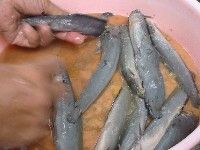
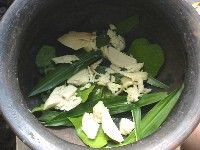
Clean the catfish with a 2-3 tablespoons of vinegar diluted in half a cup of water. Scrape the skin to remove the slimy feel. Line the clay pot with the tanglé and ginger leaves then add the ginger root.
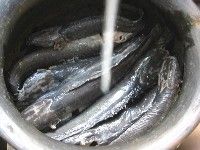
Arrange the fish side by side then pour the vinegar. Initially, cook over high heat until it reaches boiling point, pour the water then simmer for five minutes and they’re done. Note that this kind of fish dries up easily and should be cooked quickly otherwise the flesh would be too tough.
——————
Thank you Celia Kusinera for hosting this aptly themed event!
Note: The hito goes by at least five scientific names but I couldn’t find the one for the native variety on Search FishBase. I’ll update this post as soon as I get the data.
For more information on Philippine weather and climate, visit the Manila Observatory website and Typhoon2000.com – The Philippines’ First Website on Tropical Cyclones.
Update: The round-up for Lasang Pinoy II: Cooking Up a Storm! is now available.

 The Pilgrim's Pots and Pans
Leave a comment