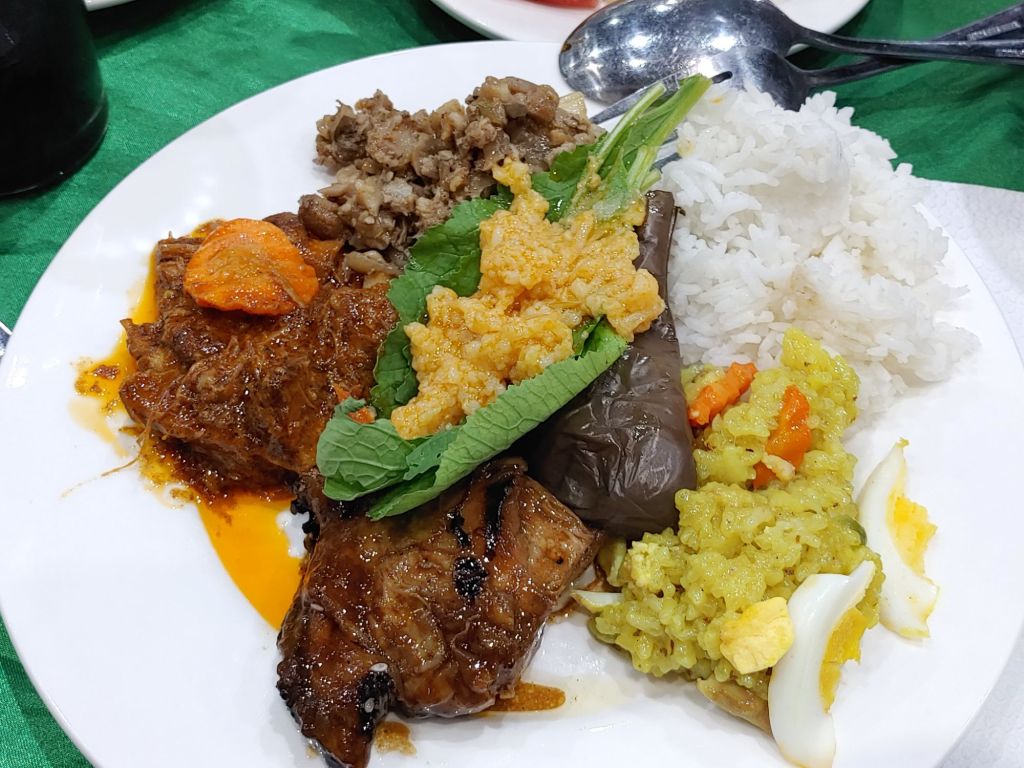
The November edition of Lasang Pinoy challenges us to think about Filipino soul food. What exactly is this? Until gracious host Minnette announced the theme, I didn’t realise soul food has its roots in African-American culture. So it IS related to soul music, which is the African-American style of combining elements of gospel music with more secular forms. In fact it used to be called Black Cuisine and only became “Soul Food” during the Civil Rights Movement of the 1960s, according to Patricia Mitchell. Furthermore, she says that “when the emancipation came in 1863, slaves soon scattered from the confines of the plantation into other parts of the United States. So as to not lose contact with family members scattered far and wide, Sunday dinners became a common time for families to get together.” Interesting! The things one learns from joining online food blogging events.
And so the term soul food has evolved to mean that which brings back memories of family togetherness and was then adapted by other ethnic groups. Which brings us back to our theme for the month. What for me is Filipino soul food? I loved the way Minnette tied this up with how we Filipinos celebrate All Saints and All Souls Days – which are almost always with family, the nearest and the dearest.
I have very fond memories of All Saints Day celebrations. It was a major event, as far as I was was concerned. Days beforehand, we would go to the cemetery to supervise the cleaning of my grandfather’s grave, clean the house and go to the market for what we’d cook on the day itself. On Daun (pronounced ‘dah-woon’), my aunties, uncles and cousins would arrive from the city.
First a note on Daun. This is how we call All Saints’ Day in Capampangan (Tagalog Undas or Undras). Literally, daun means ‘to offer’ or ‘an offering’, perhaps with reference to how we consider our dearly departed as offerings on the altar of the Lord. I am not certain at the moment how Daun came to be applied to All Saints Day which we also refer to as Todolosantos, a contraction of the proper Spanish Dia de Todos los Santos. For sure, however, it has something to do with indigenising the Christian feast day which the Spanish missionaries brought to the country. What is apparent is how inhabitants of this archipelago from proto-Filipinos (pre-1898) to our generation are noted for reverence for those who passed away or the meangu bie (meh-a-ngu bi-ye) – those whose lives have been harvested so to speak. This ‘harvesting’ as it is, directly contrasts with the Western notion of a grim reaper.
To angu or harvest has positive agrarian connotations, such as when we pick the fruits of the land upon ripening or when we cook, the moment something is done and taken out of water or oil. To be meangu bie then, is to have accomplished one’s earthly purpose and to move on to the next. Hence, it is no wonder why Capampangan, or Filipino funerals in general, are in a way celebrations of life fulfilled. Having achieved their earthly purpose, we consider our meangu bie with the communion of saints. At least that’s how I understood what several priests have told me. It therefore makes sense why we go to the cemeteries on 1 November, All Saints Day. On 2 November, All Souls Day we light candles at home.
At the cemetery, not only do we pray but also socialise. It is a time for getting together with family and old friends we rarely see. Of course whenever Filipinos socialise, food is always in their midst. I honestly do not remember much about what we brought with us when visiting my grandfather’s grave. Most probably there were sandwiches and juice for us children. What I vividly recall is that we always had butul pacuan or dried watermelon seeds. My cousins and I would munch on these to our heart’s content while our parents would chat with their old friends.
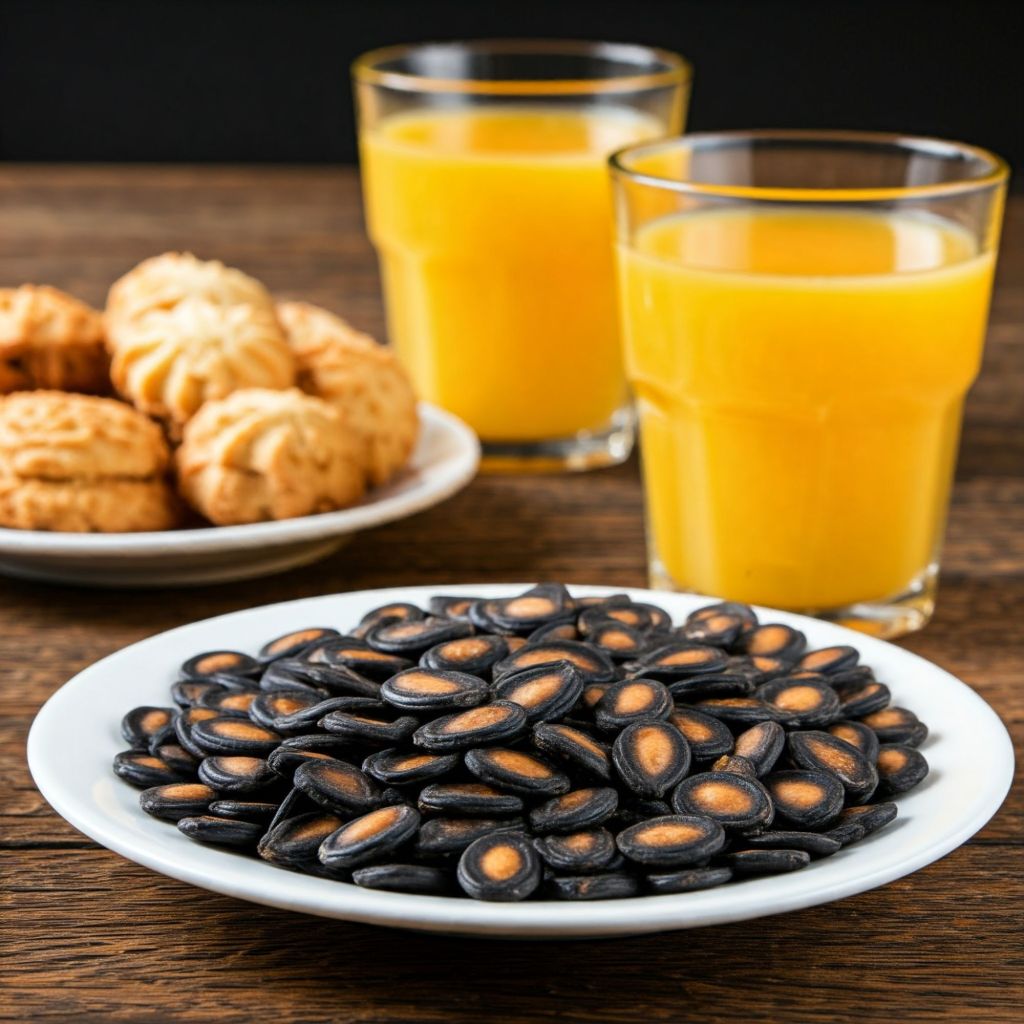
Earlier I thought bringing butul pacuan to the cemetery was just a family peculiarity. Apparently not. This year I tried to observe if there were others who also did. Oh yes there were! It seems like socialising was more fun when it went with cracking the salty seeds with our teeth and snacking on the creamy treasures encased within.
I am not sure if I will consider butul pacuan soul food but whenever I have some, I am reminded of my carefree childhood days, with the most joyful noise – laughter, singing and endless stories. Come to think of it, I do not associate just one or two items as soul food because anything we eat together as a clan becomes that.
However, what I can say is that whenever family or close friends are around, meals and snacktimes just stretch on and on. Sometimes we start with brunch – people get up very late after gossiping all night – and we just sit around the kitchen table until it’s time for merienda. As we chat, it seems nightfall just sneaks up on us. Tsk… tsk… tsk… These short interludes into our normal lives are the best times for long, slow eating.
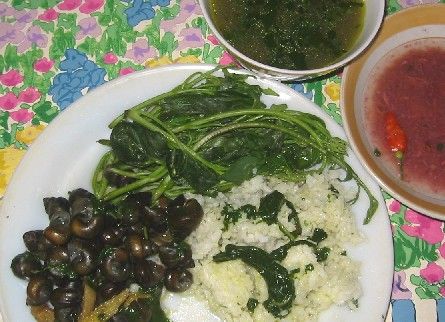
If my aunties from overseas are home, we cook whatever catches their fancy. It would not be uncommon for us to have a table full of what non-Capampangans would call exotica. Camaru, frogs, pindang damulag (cured carabao meat), tipé câmangyáng, tagilo with broiled fish and steamed vegetables, susu or snails sautéed in ginger, with squash, as tinola or any which way we fancy.
Whatever we eat during these long, slow meals are what become soul food for me. I notice that wherever I go, no matter how long it has been, when I remember the long, slow meals and snacks, the ones we eat with our hands, savour with our souls, mix with much laughter and sometimes tears – then that’s comfort food. The taste sensations bring joy but much more so are the memories – and these are what remain in my heart.
Thank you Minnette for hosting this month’s Lasang Pinoy!
++++++++++++++
Update: Minnette’s round-up is now online!

 The Pilgrim's Pots and Pans
Leave a comment