
On Friday afternoon, I went home looking almost like Cinderella before her fairy godmother’s arrival. I was carrying a clay pot, a cooking spoon, two semi-burnt bamboo tubes, two bags and soot on my dress. It was also drizzling and I had no umbrella. That most likely completed my forlorn look.
But forlorn I was not! I just had a wonderful day! Who wouldn’t if one got to sample food rarely eaten? I had a taste of something from the groaning tables prepared by public elementary and high school teachers from all the towns of Pampanga. This was for the celebration of the 434th Aldo Ning Kapampangan (Pampanga Day) with the theme Kapampangan: King Sunis, Terak, Teatru, at Apag king Dulang (In Songs, Dance, Theatre, and Food).
Never before have I seen so much Kapampangan specialties in one place. The products of each town were prominently displayed – eggs from Minalin, turrones de casoy and sans rival from Sta. Rita, puto seco from Baculud (Bacolor), pure carabao’s milk pastillas de leche from Magalang, burung asan from Candaba – name it, it was there!
What caught my attention and tastebuds most was food I seldom encountered. For the first time in my life I ate arobung dagis palé (field mouse adobo) which did taste like chicken, specifically a cross between chicken and frog, but much more tender and flavourful. I have no qualms about eating field mice. They are clean, living on grains and leaves. These are indigenous species eaten by our forebears long before the galleons came. Today’s disease-bearing rodents found in homes and sewers are the descendants of those who crossed the seas from Europe. Having said all that, I’m looking forward to eating more dagis palé in the near future.
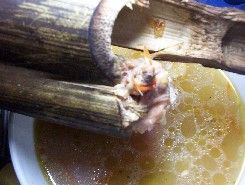
From Porac, there was some binulung paro and manuc, two soups – one of freshwater shrimps and another of chicken – cooked in a bulu. This is a type of bamboo which is more brittle than the variety used for building houses. It was my first time to eat binulu and to say that the taste was fantastic is an understatement. You have the robust flavour of native chicken, the mild sourness of camias (Averrhoa bilimbi) mingling with the clean, crisp scent of bamboo. Alternatively, there’s the sweet freshness of the shrimp. Oh, that is the life!
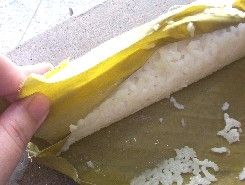
Naturally there was binulung nasi for how can we eat without rice? The teacher who cooked this specialty taught me how it is done. Abias or raw rice grains are wrapped in banana leaves then inserted into the bamboo tube. Water is poured into the bamboo then cooked over an open fire. The rice is done when the water dries up. One can break open the bamboo to get at the rice but I found it easier to just pull at the banana leaf wrapping. When I did so, oh my the scent of freshly cooked rice! Of the banana leaf and the bamboo! The bulu is still here, I haven’t thrown it away. I try to inhale the scent thinking it will not be tomorrow that I eat binulu again.
Today, 11 December is Pampanga Day. It is the only province founded in 1571 by the Spanish conquistadores, the same year as the capital of Manila. On its 434th anniversary, Pampanga is both old and new. In our cuisine, we see obviously Hispanic-influenced food like turrones de casoy and tamales. We also have American recipes like pies and tarts. There are new innovations such as adobong balut. Yet the age-old ways remain. One of these is using bamboo tubes as cooking vessels. This is very Southeast Asian. Look at nasi lemang which boo_licious featured recently. There’s also Wena’s bamboo chicken.
Oh, if you’re wondering why I was in a Teachers’ Day activity, and playing Cinderella?!?! I was invited to expound on Apag king Dulang, my take on food and culture. I had a wonderful time using a sandok (wooden spoon) as a pointer, all dressed up in my grandmother’s saya.

 The Pilgrim's Pots and Pans
Leave a comment