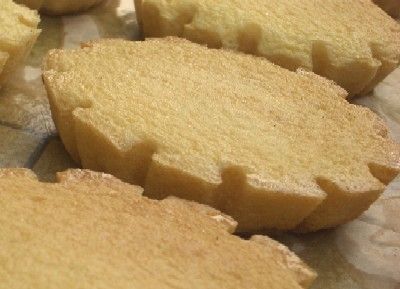
This has always been a curious bread for me. For that matter, it’s more cake than bread and its name – sopas – can be confusing. How a bread or cake can be named for a thick, chunky soup is beyond me but it is how this delightful confection has been known for generations. It is one of the staples of Christmas in our town. How do we explain this mystery?
For the December edition of Lasang Pinoy, Mike over at lafang chose the theme Pinoy Christmas Around the World. Filipinos are known to pull all stops when celebrating and this is all the more apparent during the Christmas season. The nine-day Novena Masses formally prepare us for the day itself but the common practice is, our holiday season begins in September, when households and even radio stations start playing Christmas carols. Manger scenes or what we call Belen and Christmas trees soon come out of storage. Read Mike’s announcement, which is a fitting summary of the Filipino Advent tradition. Mike asks Filipinos all over the world how they celebrate Christmas. For those of us in the country, we can talk about how we celebrate traditions that have been passed down through the ages. What an opportunity to discuss sopas!
On Christmas mornings I remember waking up to the scent of hot chocolate made from the paste of ground roasted cacao and peanuts wafting in the chilly air. Soon our relatives from pangulû (direction meaning north), the barrio or village where my grandmother was born would come over to bring us their specialties of calamé, suman and sopas.
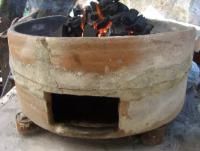
Right from the very beginning, I knew that sopas was far superior to any mamon (a kind of sponge cake) sold even in upscale bakeries. As soon as we were given some, my grandmother would always save a few pieces for anyone who was not home at that moment. We knew how much these were appreciated because they could not be mass-produced and had to baked in the traditional clay orno (oven), which was already very rare even in the early 1980s.
Through the years, I still puzzled over the name. Was it traditionally eaten with a chunky sopas during the cold months? My mother had no clue. Neither did any of the elders I asked. It has always been sopas to them. Christmas sopas was bread while regular sopas were soups eaten at any time of the year.
How interesting yet frustrating. References to Spanish or Mexican sopas never turned out breads nor cakes.
Thus I went about thinking about it. Interestingly, more than anywhere else, I have found this bread to be common in Sta. Rita and neighbouring Baculud (Bacolor) and Porac, two towns which present-day Sta. Rita was carved out from during the Spanish period.
At home, we never made sopas since we do not have a clay oven. I myself have not seen them being made and jumped at the opportunity when on the 23rd one of my mom’s cousins asked if I wanted to see them baking the next day, Christmas Eve. What I witnessed made me realise why long slow cooking brings out the essence of Christmas for families who cook together.
Early on Christmas Eve, off I went without nary a thought that I was supposed to be cooking too. I joined Auntie Teresita and cousins work on the sopas. I was surprised to find a small group of people in the backyard, where we were going to bake. I thought they were just going to watch the activity like I was, only to find out later on that at least four people were needed to efficiently bake the prized bread.
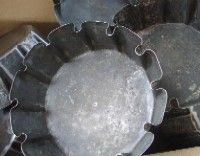
The first order of the day was to make sure the casorina (in the barrio they pronounce it ‘casarina’) were clean and dry. These are steel baking pans around 5 cm./2 inches deep and 15 cm./6 inches in diametre. They are shaped like flowers or wheels, depending on how you look at them. I was amused to learn the proper name of this baking pan. Casarina? Where is it from? Is it related to caserola? Again, I could not find the name or derivations of it from Spanish or Mexican baking utensils. Could it be a Filipino-Spanish adaptation and nomenclature? This proved to be interesting.
Next we also had to ascertain that the steel pail used for beating the eggs (sabulan) was clean and dry. They don’t make it like them anymore. Of course it was only taken out once a year and is well-oiled when in storage.
Soon my cousin Jing was breaking the eggs to be whisked. We were going to use large eggs but Ate Jing was checking the size by feel and sight because if they were more than the ‘usual’ then we had to use more flour. Precision without a measuring instrument, don’t you think? The white sugar and the baking powder was then added to the eggs. Auntie Teresita is very particular about the brand. She only uses Diwata brand. According to her, she tried using Calumet before but was not satisfied with the results.
Shortly thereafter, Ate Jing was working on the eggs with a gigantic spiral beater. I wanted to try beating the eggs but was afraid of ruining the mixture. It’s well-known that not everyone has the “touch” for the sabol. They say that some are mayan gamat literally meaning light-handed while others are mabayat (heavy). It takes around an hour of light but rapid beating for the egg mixture to attain its proper consistency.
In the meantime the oven is to be pre-heated. Charcoal is burned both on top and at the bottom. It has to be evenly distributed. The oven’s mouth needs to be temporarily covered with cardboard, just to keep the heat from escaping. The casorina have to be greased with lard. Approximately a tablespoon for each is slowly dripped into each and then made to coat the entire surface. According to my aunt, only lard will do. If wishing to cut down on lard, mix with some peanut oil.
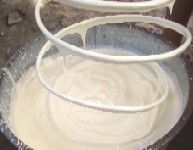
By the time the egg mixture has frothed up to fill the bucket, is snowy white and is forming soft peaks, the flour should have been sifted. Here, Auntie again is very particular to use only first class flour, also known as hard wheat or bread flour. Use something else, the sopas would collapse. The flour is then added half a cup at a time and folded into the egg mixture till all lumps disappear.
A test casorina is then filled to half and sent to the oven. After a few minutes, everything from the heat to the recipe, if need be, is adjusted according to specifications. Seven casorina are then filled, the number being half the oven’s maximum capacity. My auntie wants the heat to circulate properly and for her also to keep one pan from burning or under cooking. The oven’s mouth is covered and the contents checked every five minutes or so. A torch/flashlight finds itself very serviceable at this time.
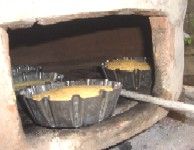
The sopas is taken out of the oven as soon as it rises to fill the pan and is golden brown in colour. It is then transferred to a sheet of well-oiled blotting paper. The casorina is then flipped and assembled to cool before packing. I was allowed to help with the flipping, hehehe!
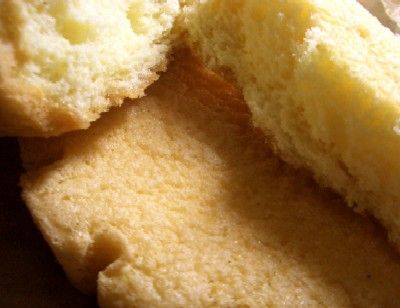
The resulting sopas is light yet firm. It is a chewy and robust sponge cake that is more resistant to the touch than the usual mamon.Chatting while we baked the sopas, Auntie Teresita and my cousins said they tended to call the cake mamon nowadays to keep from confusing it with the soup. Oh, no! I implored them not to. Losing the name would also mean losing the history, which I recently found out with a little sleuthing and with the very little Latin that I know.
There is a clue however. When Coyang Willy my townmate and partner in things gastronomic was last home from the US, I told him about this perplexing name game. Why sopas and how come nobody knows why it’s called that way? His guess – it could be related to the Latin American sopes, an open-faced sandwich sometimes shaped like a tub. But sopes are savoury, aren’t they? With a little online sleuthing, I found a recipe for a sweet sopes.
But that was not it. It was the etymology that yielded the answer: the various words for soup (soupe, zuppa) come from a late Latin word “suppa“, which means “bread soaked in broth“. In English the word that still has this meaning is the word ‘sop’. Originally these were bits of bread in liquid, but later evolved into the bread put under roasts and stews. So the dish that we call soup in various languages actually was named after the bits of bread put into the hot liquid.
Interesting, isn’t it? A little more careful research yielded the recipes for the Portuguese soupa dourada and the Mexican capirotada o sopa, which are far from being soup. They’re bread puddings that also use up a lot of eggs.
Aha! So it’s the liquid (soup) which is named after the bread and not the other way around! Fantastic to learn something new each day!
Sopas
40 large chicken eggs
4 (11 gram) packets baking powder (Diwata brand)
4.5 gatang/1.44 k. white sugar
5 gatang/1 k. first class flour (Cinderella brand)
lard, enough to oil all casarina
Makes around 70 pieces
Thank you Mike for hosting this month’s hectic and breathless edition of Lasang Pinoy!


 The Pilgrim's Pots and Pans
Leave a comment