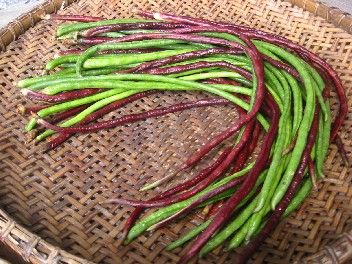
Or beans by any name taste the same…
Or beans of the same name are not the same…
Or things I learn through blogging…
They’re called câmangyáng in Capampangan and sitaw in Tagalog. All my life I thought they were called string beans in English. Weren’t we taught that at home and in school and aren’t they labelled as such in groceries? Or have I been an ignoramus all these years? Or could it be a Filipinism or a Capampanganism? How did I find this out if not through blogging? As it happens, in some parts of the world, string beans are what we call bitsuelas (habitsuelas in Tagalog) or Baguio beans here. They are also called French beans, green beans and snap beans in some places. Oh what confusion! But then again, that’s why common names are almost always common only to a place. If I travel to another country, how do I get what I want if I can’t see it yet? The scientific name! Vigna sinensis for the beans you see in the picture above and Phaseolus vulgaris L. for the snapbeans, the picture of which I will take the next time I am in its presence. Hehe, as if people in restaurants and marketplaces are conversant with the system devised by Carolus Linnaeus. “A plate of Arachis hypogaea and some Zea mays on the cob to snack on, please.” That would be the day!
Now, how did all this begin? In mid-November, Renee at Shiokadelicious! posted her Long Horny Beans entry. In the succeeding discussion we found out that what we call string beans in the Philippines and in Singapore are not the same species. From the comments it dawned on me that the Tagalog sitaw is most probably closely related to the Hokkien chai tau. Ooohhh, it was getting interesting, related to what I was planning to trace food pathways. But that’s for another post.
And so started my case of the beans with many names. Since the internet was full of sources from all over the world, I thought I’d do my homework on base turf first. Good old-fashioned book research did it. I took out a copy of the Philippine Seed Catalogue and what did I find? More confusion…
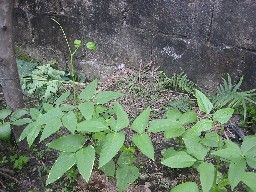
It seems like what we call the câmangyáng is not just one plant; those are seedlings you see in the above picture. The Vigna sinensis (Stickm) Savi or Hassk is also known in other Philippine regions as kibal or paayap. In English, it is called the cowpea perhaps because they also feed it to livestock. This is an annual bushy legume, the pods of which are light to dark green when immature and creamy to light brown when mature.
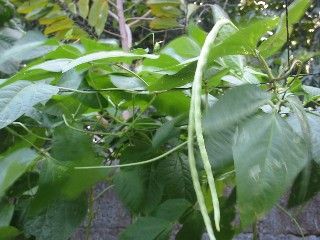
Now, a longer variety of câmangyáng or sitaw is the Vigna sinensis var. sesquipedalis Fruen. W. This is actually a sub-species of the cowpea but is longer and a bit fleshier. Its tender pods and young leaves are used as vegetables (see my IMBB entry for the recipe).
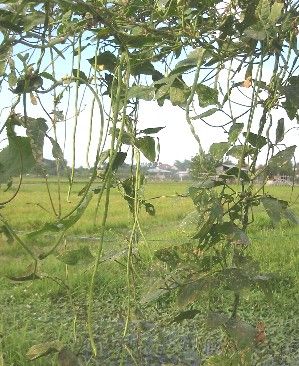
Both plants are vines grown on trellises. But here’s another one to thicken the soup, er, plot. There is a cultured variety called a dwarf bush sitaw and is a cross between Vigna sinensis (cowpea) and Vigna sinensis var. sesquipedalis. It was developed for its size, length, colour of pods and palatability.
Now if you ask me, which ones are on the main picture above? My guess is that they are either the cowpea or the bush sitaw. I’m not sure. What I know is that I much prefer the firmer variety when cooking soups and stews, as they don’t turn mushy with reheating.
Let me find a farm and some books soon, perhaps then I will know. Now the nerdy side is about to run loose!


 The Pilgrim's Pots and Pans
Leave a reply to Unity in Diversity – The Pilgrim's Pots and Pans Cancel reply