
“Aah, ginilu! Your Lola always made that on Good Friday.” My uncle was nostalgic while watching me cube the jelly. That was also how I remember it. On Good Friday, the adults fasted but could partake of the beverage. It has been more than a decade since we had it. And it has almost been a decade since I was home for Holy Week (Maleldo in Kapampangan, a contraction of Mal a Aldo, literally Holy Days, Mahal na Araw in Tagalog, also still in use, the Spanish Semana Santa).
Ginilu is a refreshing beverage, perfect for sweltering summer days. What puzzles me is why we only had it on Good Friday when it doesn’t take much to make. My mom doesn’t have the answer but the most probable explanation is that the coconut milk used for it is the excess of what is used to make bico, another traditional Holy Week food, which would make one think – meatless but rich nonetheless.
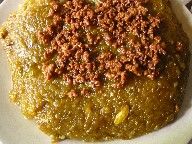
Good Friday fasting in the Philippines always had hints of a feast. How can we consider fish as a Lenten penitential food, when it basically makes up our everyday fare? Whenever Filipino families come together, it always has connotations of a feast. And on Holy Wednesday and Good Friday evenings, we await the processions of religious statues depicting the Lord’s passion. This takes on the scale of a full baroque pageant, with the carros (carro, sing., life-sized tableau, from the original Spanish that means ‘carriage’ or ‘trolley’) decorated with flowers and lights, the religious images in full bejewelled gowns, not too different from what Katia and Ronald’s account of Easter in Ispica in their Via Ritiro N. 7 Diary. In our town and many others, violins and a full choir singing the Stabat Mater only adds more to the spectacle. In a way, it is both solemn and dramatic.
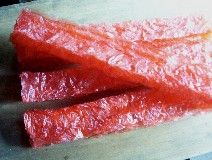
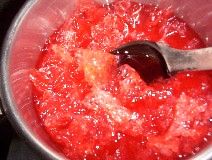
To make this beverage, we use gulaman, which is a generic Filipino term to mean either gelatine or agar-agar. In the Philippines, and most of Asia probably, agar is more commonly available than animal by-product gelatine. This is made from seaweeds and is the choice for vegetarians and vegans, is kosher and halal. Gulaman is sold in markets and groceries in plain and coloured dried bars, which is shredded and boiled till thoroughly dissolved. In this case, a very small amount of sugar was added to the boiling agar just so it doesn’t taste too flat. It then sets at room temperature and can be facilitated by setting the pan in a basin of iced water.
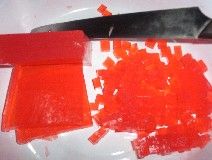
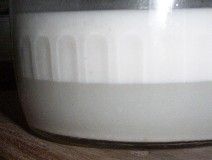
The gulaman is then cubed into desired size and set aside, to be added to the coconut milk just before consuming. When we were children, my brother and I, together with our cousins would always volunteer to “help” slice the gulaman for very obvious reasons.
As for the coconut milk, it cannot be overly emphasised that it has to be thin enough to be drunk, otherwise the cream will harden as soon as ice is added to the liquid. To do this, after pressing the shredded coconut meat, let the liquid stand for around 15 minutes until the cream floats on top and skimmed off. A small amount of sugar is then added to the coconut milk, to taste. (1 mature coconut = 6-8 cups of coco milk)
Coconut milk and cream is also sold canned in most Asian groceries.
Happy Easter my dear friends!


 The Pilgrim's Pots and Pans
Leave a reply to IMBB 15: Pilgrim’s Milk Tea (Has My Blog Jelled?) – The Pilgrim's Pots and Pans Cancel reply