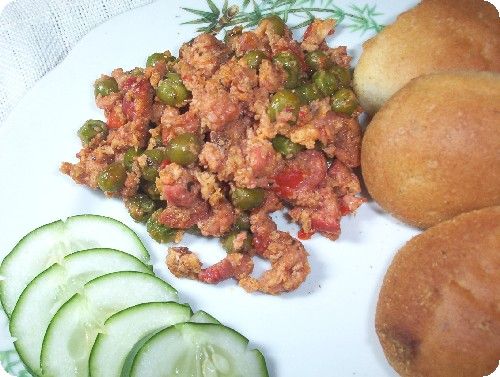
Look at breakfast, how festive it is
For sure you’re going to like this
Meat and peas – no pressure
Of course, a few eggs for good measure
Alas we have a meal we can’t miss!
That would somehow summarise pistu for me – simple, yet special. It’s fiesta season and what do Capampangan tables have in common? I would say pistu for breakfast.
For this month’s edition of that non-event event – the End of Month Egg on Toast Extravaganza (EoMEoTE) – which Jeanne at Cook Sister is so graciously hosting, I tried to let the rhyming flow – to the detriment of the genre, as you can see.
According to Gene Gonzalez, pistu (he spells it ‘pistou’) is a recipe derived from the Basque piperade, which is “a dish of mixed vegetables”. However, my friend Stephanie Patag, who is also an avid food researcher, found one of several recipes for Spanish ‘pisto’ from the Castilla-La Mancha region and says it is as colourful as ours.
Upon further research I found out that in Spain it’s called Pisto Manchego and its origins are indeed from the Murcia, Castilla La Mancha and Extremadura region. It is cooked with fresh tomatoes or tomato sauce and is served with fried or scrambled eggs. The Spanish word ‘pisto’ is from the Latin pistus – crushed or ground – which is derived from the Late Latin pistāre which means “to pound” or “to beat”, referring to how the ingredients are prepared for cooking.
How this humble peasant dish of vegetables evolved into an omelette for fiestas in the Philippines, specifically in Pampanga, is something worth further investigation, don’t you think?
The dish is very simple, it can be whipped up in the most rudimentary of kitchens. The ingredients are also available all year round in almost any marketplace. It makes me wonder why in our household, we seldom have it. Other families in town seem also to associate it with special breakfast occasions.
My mom says she remembers my grandmother cooking this on early fiesta mornings to serve guests who drop in for breakfast, usually coming from other towns to hear early Mass. Other more elaborate dishes would be for later in the day.
At home, it is usually only on the feast of Santa Rita, sometimes on Christmas or some other special occasion that we cook pisto. Then it is eaten with special pandesal (contraction of pan de sal, literally bread of salt in Spanish), a bread the size of dinner rolls but crustier. Pandesal is the Filipino everyday bread but the special kind, a bit more dense and flavourful, was baked only on special occasions like Christmas and the town fiesta.
I can imagine that centuries ago, when conditions were different, when imported food supplies (such as wieners and green peas) came in only at certain times of the year, they were used more sparingly. With the improved transportation and trade, this has been changed but the memories that grew out of the past situations are still indelibly printed in the heart.
In Sta. Rita are found two very similar but distinct recipes for pistu. In barrio San Jose and thereabouts, we use ground pork while those from neighbouring San Vicente and adjacent San Matias do away with it. The vegetables and sausages used are the same.
Below is my grandmother’s recipe.
Pistu
1/2 kg. finely ground pork
1 or 2 pcs. chorizo de Bilbao, crumbled
1/4 kg. wieners or plain hotdogs, diced
1/2 cup frozen green peas
2 capsicum/bell peppers, finely chopped
3 eggs, lightly beaten
1/2 cup tomato sauce or fresh diced fesh tomatoes, cooked till soft & reduced to a paste
1 head garlic, finely crushed
2 medium onions, finely sliced
2 tbsp. cooking oil (lard is best)
bay leaf
oregano
salt to taste
Heat oil in a wok or pan. Fry garlic till golden brown then caramelise onions. Brown the ground pork and chorizo then season with the herbs and salt. Pour the tomato sauce and let simmer for 10-20 minutes, adding small amounts of water if it gets too dry. When the pork is tender, add the sausages then the green peas. As soon as the green peas are soft enough, add eggs and stir to combine properly. Turn off heat and cover for five minutes or so.
Serve with toast and fresh vegetables.


 The Pilgrim's Pots and Pans
Leave a reply to Rebuilding This Food Blog, One Post at a Time – The Pilgrim's Pots and Pans Cancel reply