Note: revising still but comments welcome
We chose to launch Lasang Pinoy, a Filipino food blogging event, on Ninoy Aquino Day to commemorate the death of our most well-known modern-day hero. Today, Filipino food bloggers and friends in many parts of the world will post their thoughts on being Filipino and the food that go with them.
Try as I might, I cannot recall what I was doing on 21 August 1983. Perhaps it was my typical child’s day of play, homework, raiding bookshelves, piano lessons, cartoons and whatever a nine-year old third grader would do. The day after is what I vividly remember.
My mother was reading the papers early in the evening, and in a tense and troubled voice confirmed: “Mete ne pin y Ninoy” which is Capampangan for “Ninoy is really dead”. I had no idea who Ninoy was but it seemed that he was someone my mom knew very well. Could he be a relative or a very close friend? I was sure he was either one.
He was not! Ninoy Aquino was a senator. What was a senator? We didn’t have senators anymore, according to Mom. Oh, there were so many things explained to me and my little head was probably spinning yet trying to understand. All I wanted to know was why Mom was so shaken she seemed to almost cry. My mother? She’s unflappable so this must be a major catastrophe. Little did I know that it was indeed a catastrophe of national proportions but one which would bring us out of the depths years later, like a phoenix rising from the ashes.
The next few days seemed like a whirlwind. We were tuned to Radio Veritas the whole time and glued to the TV set for the coverage of Ninoy’s wake and funeral. Although we were in Pampanga, out of the raging firestorm, we also felt the tension. How could we not when the province was once again the hotbed of revolt, especially that Ninoy was a Kapampangan Tarlaqueño. What if more people were killed? What happens after the funeral? Will a revolution erupt?
And then suddenly everything made sense – the visitors who have been coming to our house, the college students who sleep over now and then, the priests and nuns who come in civilian clothing and seem to be talking about very important and worrisome things all the time. You see, one of my aunts is a missionary Benedictine sister and was very active in the protest movement long before the Aquino assassination. My mother was eventually involved and to a certain extent even my grandmother who was 83-years-old in 1983.
In the days after 21 August, even we children held prayer vigils in school, found ourselves with black and yellow ribbons, buttons and T-shirts with “Ninoy, ‘Di Ka Nag-iisa” (Ninoy, You Are Not Alone) emblazoned on the front. In the events that ensued, my brother and I would often be brought along to symposia, rallies and peaceful marches which were often held outside the gates of Clark Airforce Base in Angeles City. The American bases (Clark and Subic in Olongapo City) were according to the protesters, festering sores which symbolised the Filipino people’s servitude to the “US-Marcos Dictatorship”.
It was in these venues that I saw people from all walks of life come and break bread (er… share rice?) together. Side-by-side on the pavement were doctors and fisherfolk, carpenters and students, judges and market vendors – practically anyone one can think of. In many of the events we went to, we would bring food like sandwiches and meals if it was a day-long activity. My grandmother would pack us lunch in her sturdy pombrera, which is a three-tiered round lunch box with a handle. We also brought something extra to share.
The one event which is unforgettable for me is the Tarlac-to-Tarmac March – a demonstration which started in Ninoy’s birthplace in Concepcion and ended at the then Manila International Airport where he was gunned down. It was where people walked (or rode) and had many stops in between where speeches were heard and songs sung. It took six days and around half a million people participated. On the Dau to San Fernando leg, my mother and most probably my auntie brought us to the rally.
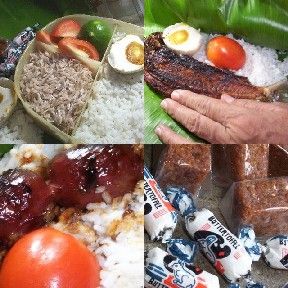
During mealtimes, what impressed me most was how everyone shared their food. The spread showed the difference in economic status of the people who were there to have their voices heard and perhaps just to be together. Like the people which brought the edibles, rich man’s fare such as roasts and imported fruits were side-by-side with peasant food like tuyo and canned sardines. Dessert meant candies such as White Rabbit or plain bukayo (grated or strips of coconut cooked in molasses or sugar till solid). Food was actually not a problem because every so often, there would be donations of packed meals and snacks from private individuals and business institutions.
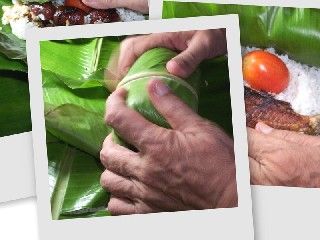
The most memorable food however, was what the farmers brought with them – simple fare of rice and usually fried fish and a tomato or two. Now and then there could be a piece of dry adobo or homemade cured meat. This was then wrapped in banana leaves that gave it a certain fragrance. This is quintessential Filipino mobile food. It is most memorable because it comes with them as they take the time out from back-breaking work to stand up for what they believe in, oftentimes their lives threatened.
Looking back, 21 August 1983 holds much more personal significance than I give it credit for. I may have been a mere child then but the events that stemmed from that day have influenced many of the decisions I made and will make as an adult. My social lenses have been strongly formed by the movements of that time. I love the Philippines enough for me to stay here and work to make it better. I love it enough for me to want to better understand the different cultures that co-exist within. Most of all, I love my country enough to make me want to know myself and my roots better. And that is the reason for the existence of this blog.
+++++++++++++++++++++++++
My entry for this event is daing na bangús or fried cured milkfish (Chanos chanos). Milkfish is the Philippines’ national fish. Although it is bony (madui or matinik), it is still sought after for its taste and versatility. It is eaten as everyday food and also served on special occasions.
Daing Bangús: Fried Cured Milkfish
2 medium-sized bangús (milkfish, Chanos chanos), gutted, butterflied, unscaled
1/2 cup pure palm vinegar (sasa or sukang Paombong)
1 head native garlic, crushed (more if using the large variety)
a dash of black pepper, roughly crushed
1/3 teaspoon salt
a pinch of sugar (optional)
1 tablespoon cooking oil
When curing bangús for daing, we leave the scales because marinated for a long time, the vinegar softens them and the bones anyway. Scaling it would also leave the fish too soft it could disintegrate when frying.
In a deep container, prepare the marinade of vinegar, black pepper, salt and garlic. Thoroughly rub the fish with garlic. Immerse in the mixture and leave to marinate in the refrigerator overnight, at the very least. It will keep for a week or two.
Upon curing, in a shallow pan, fry to desired doneness. What I usually do is to initially cook the fish in very high heat for a minute then lower the flame to cook evenly. If it’s a relatively small fish, frying it well makes the bones crunchy enough to eat.
Serve with salted eggs and tomatoes, or spicy-chilli vinegar.
The picture above shows a very well-done daing because wrapped food that will be under the sun for a long period of time, such as in rallies, needs to be well-cooked. The rice is also lightly sprinkled with salt before wrapping to avoid spoilage.


 The Pilgrim's Pots and Pans
Leave a reply to A Different Kind of Thanksgiving – Guest Blogger – The Pilgrim's Pots and Pans Cancel reply