[Originally written for the PinoyExpats monthly online magazine.]
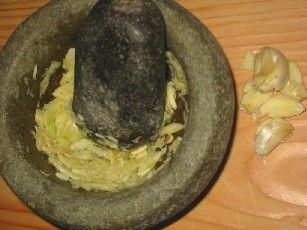
What a fossil I am! I could be one of the last of my generation trained by grandmothers who were alive before the Second World War. Apprenticed by Lola the Keeper of Kitchen Traditions says a lot about my current cooking style. For starters, my sauté has garlic crushed with a mortar and pestle, not minced, no garlic press. There’s a difference in flavour and texture, mind you. Then there’s guisang saguíwa (lightly sautéed, almost raw) and guisang mátusta (sautéed till golden brown), depending on what dish I’m preparing. There are a thousand and one ‘major’ and ‘minor’ rules of the Capampangan kitchen which I’ll discuss shortly.
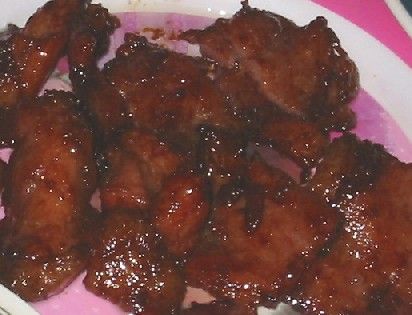
Who am I kidding? I’ll bore myself to death if I did. I can’t dazzle with recipes and cooking techniques. I’d rather talk about the little discoveries I learn from being a nosy brat. Example: Until around three decades ago, Capampangans did not eat tocino but they had pindang and this was of the best quality – venison, carabao meat, beef and pork. What happened? How did tocino (a.k.a. bucayong babi according to Lola) overtake the age-old pindang? Ah, my research is still unfolding. But this I know – Pampanga exported cured venison or pindang usa to China and Japan for a very high price even in pre-colonial times. Source? The early chronicles of Spaniards in the Philippines.
There are also many details from food which reveals the shared culture between Filipinos and other Asians. My earliest introduction to food anthropology and which fascinates me still would be how our tâgiló/balo-balo or burong hipon relates to the Japanese sushi which did not originate from the Land of the Rising Sun. The practice of preserving fish with rice, with the rice thrown away later, started out in Southeast Asia then moved northward to China and Japan and evolved to its current form. In Southeast Asia however, some of this original method remained, like kassam in Borneo and as it has evolved in the Philippines, buro in many Luzon provinces.
Rice, being the staff of life in these parts, seems to occupy the highest level on the altar of food. We have rice cakes – from the full-grain bico to the ground rice calamé and bibingka, which by the way, may not be as native as we think. It may not even be Southeast Asian. In Goa, Macau and East Timor we findbebinca. which are cooked almost the same way. We can argue that these use flour instead of ground rice like our bibingka. But if we go a bit back in time, we also encounter more specific terms as bibingkang cassava and bibingkang kanin (bibingkang nasi for us). Could this be our own adaptations, just like how we now use rice for our tamales as against the original cornmeal for the Mexican tamal? The Philippines may not have been under the Portuguese but Manila was a major trading port. Could it be that the original recipe for bebinca may have come to us on a ship from the Indian Ocean or South China Sea?
Still on rice: it appears we also have a habit of eating it with fruits and I don’t mean when they’re cooked together in a bico or suman paired with mangoes. Eating plain white rice with mangoes, guavas, chicos, pineapples, watermelon with rock salt or bagoong is what I mean. Initially, I thought this was just Lola’s annoying habit, since she would almost force my brother and me to eat our fruits with rice. Apparently it seems common to Filipinos from Aparri to Jolo. It’s practiced among Malays and Tamils too!
What a wonderful walk, this through the world of food. It’s more interesting when eating and learning is shared with real-life and virtual friends. In planning Lasang Pinoy event, several Filipino food bloggers had e-mail discussions which ranged from the logistics to authentic Filipino food. In one of these exchanges, Minnette of Lafang List and I had an interesting conversation on guinataang halo-halo. And then it dawned on me: In Capampangan the term for guinataan is sampelut or sinantan. ‘Gata’ in Malay is? Santan!
Then there’s the Islamic connection. Many of us instinctively think of escabeche as Filipinised Spanish food. We also share it with many Latin American countries, albeit with variations. It may have gotten to the Philippines by way of the galleons but it is not really as Spanish as we think. The food writer Clifford Wright has this to say: “The Arabs ruled both Spain and Sicily for centuries, and as a result the word escabeche can be traced to the dialectal Arabic word iskibaj, which the great lexicographer Joan Corominas describes as deriving from the older sikbaj, meaning “a kind of meat with vinegar and other ingredients.”” From it ‘ceviche’ is also derived and is equivalent to the Filipino kinilaw. From Sabah there is hinava and the Thai dancing shrimp salad. So, Filipino kinilaw could be Arabic-influenced (they traded with us for centuries before Spain came to our shores) or it could be something common to Southeast Asia and the Pacific – there’s a version in Samoa too. Interesting, isn’t it?
What got me thinking about this? When I was a child, Lola now and then explained cooking terms and practices from the olden days. Keeping that in mind, it is now easy for me to trace and compare patterns. Final example: Kesiap was common in Pampanga until recently. This was in no way made from tomatoes or bananas. It is like patis but much, much more flavourful and fragrant what with cinnamon sticks added. The astute reader may now notice that ‘kes-yap’ is very similar to how the Indonesian kecap is pronounced. See the connection?
In trying to find out more about Filipino food, what comes into the forefront is how interlinked we are to neighbours, especially with our fellow Southeast Asians. Instead of thinking of ourselves as simply influenced by our neighbours, perhaps it is more prudent to think that we are one of them. What is indigenous to them most probably has indigenous counterparts in our culture. After all, our forebears were plying the borderless waters of Southeast Asia for centuries before the concept of western political boundaries hindered their movement.
Today’s mainstream food discussions always centre on “classic Filipino recipes” such as afritada, caldereta, embutido and other Spanish-influenced dishes. I found a website which even confidently asserts that Filipino food is 80% Spanish in origin. I cannot agree. Food we serve during celebrations is Spanish-influenced because they introduced fiestas. However, ‘local’ dishes we have on ordinary days are much more prevalent and we need to give them equal importance. The Filipino daily fare of tuyo, dinengdeng, paksiw, law-oy, tiulang itum, sagaksak, tinola and nilubihang munggo are what sustain us. It is this indigenous cuisine which has changed little or has absorbed foreign influences that has continued to be traditionally from these islands. After centuries of colonial rule and various influences, we may find that at its core, it remains our own.
In the larger quest to find our identity, I find food to be a good entry point. I have said several times that learning about food traditions has made me a better Filipino. Knowing where to start is almost half of the battle won. Am I glad I paid attention to Lola’s kitchen lectures!
Bio: Karen chases the wind, paints with the rain, and watches plants grow. In her spare time, she tries to find out more about Filipino culinary traditions and blogs at The Pilgrim’s Pots and Pans.


 The Pilgrim's Pots and Pans
Leave a reply to Can I have a catnap? – The Pilgrim's Pots and Pans Cancel reply