by Manny Soriano
The following entry is contributed by a Filipino-Canadian food and music enthusiast. He was born and educated in the Philippines and migrated to Canada in 1971. His mother was an excellent and practical pastry and savoury cook who operated a hotel with his father who was a coffee and cigar connoisseur. Manny started baking in highschool and worked as an accountant till 1999. He took baking courses since 1990 and opened a Filipino pastry shop in the west end of Toronto in 2000.
The hurricane that recently submerged the American gulf region has a particular vivid resonance for us Filipinos because the majority of us who have not left home live through the same fear and threat year in and year out. It seems that political leaderships everywhere are all alike in being blind, deaf and dumb to this never ever unforseeable disasters. In the coastal area of Tondo, the project that was designed to lessen the problem ended up aggravating it through corruption and bungling. Now they have flood all year round. How do our resilient people cope and survive, go on with their lives and rebuild? The only patch left to them for refuge is dangerously sloped and rather slippery at that.
You hear talk of the ruinous effects of global warming getting louder each year. That there is going to be stronger hurricanes, that more frequent floods will marinate more low-lying areas. But shall we claim that we have already been living through all these grim conditions in the last two centuries for which we have written account? The Spaniards summed up our climate as “cuatro meses de polvo, cuatro meses de lodo, cuatro meses de todo.” That adds up to two-thirds of the year being wet season. So apt then of Bino Realuyo to call his coming-of-age novel “Umbrella Country” or of our great painters invariably depicting Habagat (Monsoon) as a dark and sullen giant.
Separated from reality by time and distance though, the more fortunate among us who have established a foot-hold abroad only have kind memories to summon, remembrances of our care-free childhood, of house-bound days, of crowding in the kitchen for warmth or to join the rest of the family in turning out damp weather favorites and of immense pleasures and enjoyment afterwards. The hurricane harried fishpond owners of my town might have lived in constant fear of breached levées or of the swarming pests that ravage the food of his precious bangus but for us kids the rain was welcome because it brought with it talangka in abundance. Mother simply salted them and left them overnight for breakfast or lunch. Nothing spells out tag-ulan for me more than my meals of burong talangka with a squeeze of kalamansi, dayap or even kabuyaw. Even later on, when the enjoyment of eating them was severely tainted with the risk of deadly diseases.
But when trully inclement weather forbade us kids to even venture out, we gathered round the kitchen table to watch mother make empanadas or actually lend our small hands in turning out gulgoria*. The memory of those empanadas was what prodded me later on to develop a recipe that I could use in my shop that sold empanadas alone and hopia. The remembrance of making gulgoria with the whole family though rolls up into one neat little package all those gentler and more peaceful days of youth.
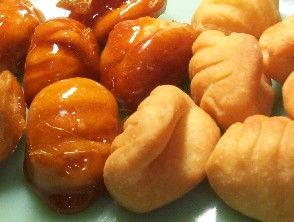
* For those who are not familiar with gulgoria, it is a syrup-glaced fried cookie formed by rolling with your thumb a small ball of dough against a section of banana trunk (saha). It is exactly the size and appearance of gnocci.
Gulgoria
1/2 cup lard or butter
2 cups all purpose flour
1 teaspoon baking powder
1/2 teaspoon salt
1/4 cup or less milk
1 eggA fresh batch of fying oil
A fresh batch of fying oil
Mix together all the ingredients until a stiff dough is formed. Knead until smooth. Roll into a rope less than an inch in diameter. Pinch off from this rope pieces the size of large marbles. Roll into a ball, flatten and press against a fork, pick up one end roll into a loose shell. This is a family project up to this point.
Always make sure that kitchen is free of children when deep frying or making syrup. Fry until golden brown. Dump into the prepared syrup and coat evenly by turning with a wooden spoon.
Syrup
1/2 cup sugar
2 tablespoons water
Place sugar and water in a frypan over medium heat stirring occasionally until the syrup reaches candy stage, that’s when the syrup dripping from the lifted stirring spoon forms into thread.
(After this recipe, gnocchi here I come! – Karen)
Update: The round-up for Lasang Pinoy II: Cooking Up a Storm! is now available.

Update by Karen (11 October): the picture on the left are the gorgoria that I bought at the Likha ng Central Luzon Trade Fair. They are from Bataan. Texture and taste-wise, they are very similar to pilipit, a braided or twisted Filipino biscuit. If I want my gorgoria to turn out this way, perhaps I should substantially lessen the amount of butter and milk in the recipe above.


 The Pilgrim's Pots and Pans
Leave a reply to Revisiting Gorgorias, Now with Palipit – The Pilgrim's Pots and Pans Cancel reply