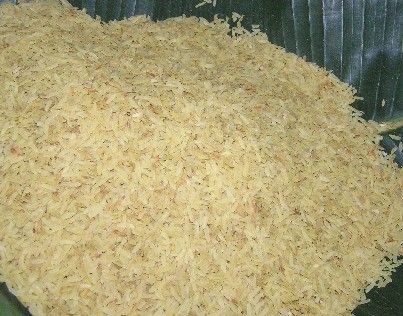
First of two parts
We were told to value every grain. Every single precious one was handled with reverence. We could not indulge in it for it was no ordinary cereal. Duman, the delight of my childhood, my current unfolding mystery. Little did I know that it would take me home and send me searching the world for clues to the past – of relations forged across the seas. Or were there?
My personal pledge last year to learn how duman gets to the table from the field was fortunately accomplished. Quite fortuitous too that for this year’s Duman Festival, Arti Sta. Rita held an exhibit to better understand how duman is made. It took several weekends for me, Terence, and Herbert, two of Arti Sta. Rita’s multi-talented members, to get the right pictures of lacatan malutu (red-husked glutinous rice), the specific variety from which duman is made. With our literal “field trips” we realised how special these plants are. There was a very precise method sustaining this tradition.
The early morning excursions we started on the last week of October opened our eyes to a part of Sta. Rita we seldom see.
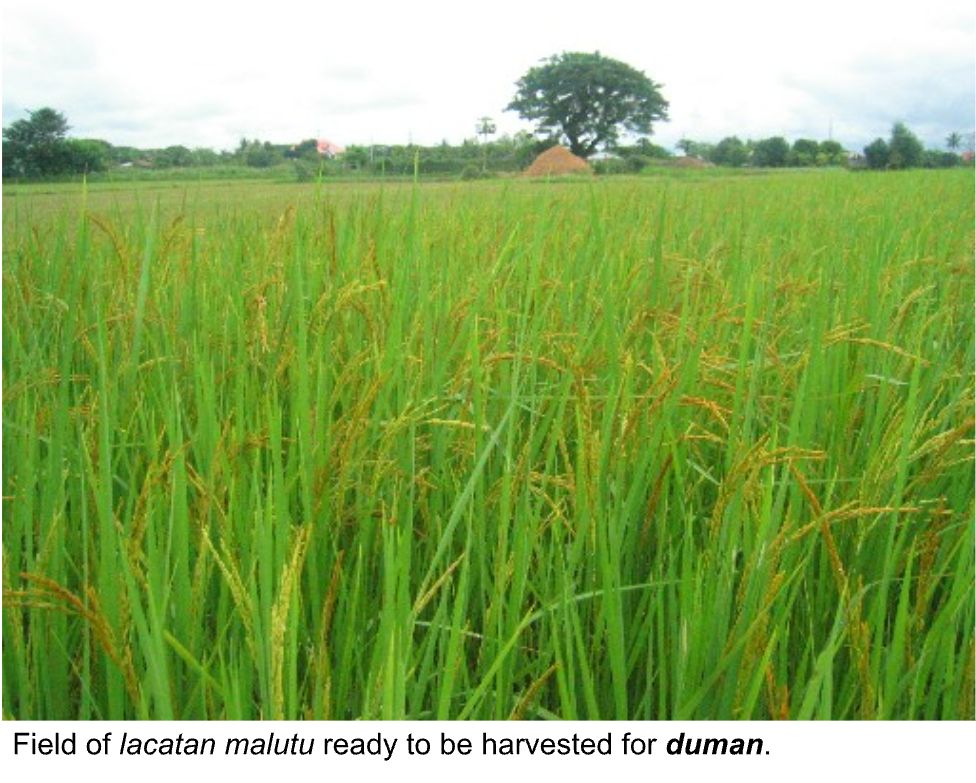
All three of us having grown up (well, the boys are still growing) in the town proper of barrio San Jose, the verdant green ricelands of (barrio) Sta. Monica were not unfamiliar yet held secrets we were eager to learn. I am no stranger to ricefields but the first time I saw the waving stalks of lacatan malutu, I was entranced. There were yet to be visible grains on the plants but the colour of the leaves caught my attention. They were much greener than palé – regular rice plants – of comparable maturity.
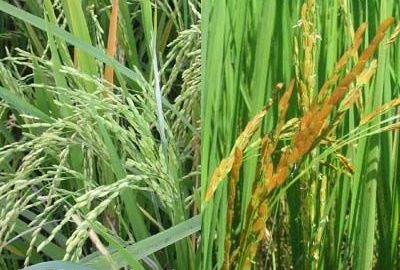
To plant lacatan malutu is both a science and an art. The bini or mature grains for planting are carefully chosen. These are selected manually, with care. Only robust grains are taken. Those with pale husks are discarded. Sowing happens with the onset of the rainy season, from June to August. Planting earlier would be pointless, the plants not bearing grains until they feel the tiup ning amiam (amihan, the cold northerly wind) during the last quarter of the year. Planting much later than that, the lacatan malutu grains would come out in January or February, amiam not on its first blush would leave a bitter aftertaste to the duman.
I was also struck by the height of the lacatan malutu. We were told by Tatang Estong (Narciso), the gentleman who let us visit his field anytime we wanted, that upon planting between June-August, the seedlings had to be cut like grass otherwise they would grow too tall that even mild winds would damage them. Optimal height was at around 1.5 metres/five feet. It also had to be on soil which was medio maina (not too fertile), unfertilised, and querayuman (keh-rah-yu-man) or rain-fed. Deviating from this would result in plants that had too many leaves, not enough grains and when harvesting time comes, the husk would be too tough. The duman-makers would have a hard time pounding the grains.
What fascinated me more was the language of tilling. All my life I’ve been proud to know I spoke fluent more than average Capampangan (shades of Lola, you see!) but on the farm I felt like an ignoramus. If it were in English, I would say they were using the jargon of farming but in my own tongue it was poetry! The buticas or the first sheaf of grain in the field is also called mamalita, the messenger. There were easily a dozen or so more outside our vocabulary that we had to ask what they meant and of course, the nerd that I am tried to trace their root words.
Right in our hometown, within walking distance from our houses was another world. If not to prepare for the Duman Festival exhibit, we might not have discovered it. And so we continued our forays, trying to be familiar with the plants. Herbert observed how the stalks of the lacatan malutu were much thicker near the roots compared to regular rice. So were the leaves, their ribs also much more pronounced. I was reminded of my laboratory classes where I would supervise students measuring the dimensions of their “pet” plants. I am not sure how it was for Herbert and Terence but after three visits to the field of lacatan malutu, I felt that I could identify how much the sheafs of grain have changed in size and colour. Perhaps it was the early hour after sleepless nights or the fresh sweet scent of the air that made me think the waving plants were beckoning, telling me to listen carefully. They had secrets to tell, I only need to pay attention.
Next, the second part Duman: Epitome of Artisanal Food


 The Pilgrim's Pots and Pans
Leave a reply to Rebuilding This Food Blog, One Post at a Time – The Pilgrim's Pots and Pans Cancel reply