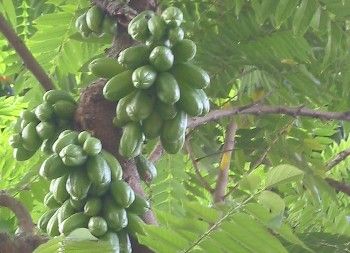
Every now and then, I encounter people touring some foreign visitors and when they point out certain native fruits and vegetables, they always say that these are found “only in the Philippines” which is of course inaccurate. There are instances when I hear our cabalen coming from overseas astounded to find exotic ingredients and ascribing them to the locale where they first found it when it actually is an import in that country. But the most common experience that I have encountered is when we use different names for the same ingredients or use the same name for different ones. It is in the spirit of knowing more about the food we eat that I write about very common ingredients – even those we take for granted.
Take for example something that most probably grows in every other backyard in the country.
Mainly known as camias (Averrhoa bilimbi) in the Philippines and bilimbi, tàling pling, belimbing assam and many other names elsewhere, it is indigenous to the Asian tropics. The fruits grow in bunches on a small tree of 5-10 m. high, are greenish yellow to light yellow when ripe, 6-9 cm. long with 3-4 flat, light brown seeds. They are succulent (very juicy indeed!) and taste tart to very sour.

However, there is another variety which has smaller, rounded and sweeter fruits which seems known only to the Philippines. I have personally seen and tasted this variety but it has been at least 15 years ago. Another one on the search list, I suppose.
The sweet camias was in my cousins’ backyard but we have always had a (common) camias tree or two at home. When we were children, we used to help with their upkeep by watering them during the summer and thinning their leaves during the rainy season (June till August) in an effort to make it bear fruit. Although bearing fruits almost the whole year round, it is during the summer when they are heavily laden. Sometimes branches would break from the weight alone.
Highly acidic, the fruits are eaten raw (sisigan) – dipped in a bit of salt and sugar, used to flavour soups and stews such as sigang, alpa and pangat, juiced and preserved as candies and jams and into a lot of other recipes sour-loving Filipinos cook.
The camias fruits are also used to remove stains from skin, brass, porcelain and cloth. Mash two handfuls of the overripe fruits and mix with a cup of water. Apply the mixture on plates, tiles, sinks and toilet bowls overnight. You’ll be pleased with the results when you wash it off the next day.
Watch this blog for a most common but mouth-watering recipe using camias.
——
By the way, for biodiversity conservation measures, I would like to take this opportunity to ask readers to please let me know if you still find the less common, rounded and sweet camias fruits in our province. If you still have trees bearing fruits I would like to ask for some overripe ones to grow into seedlings. It has really been a long time since I’ve seen them.


 The Pilgrim's Pots and Pans
Leave a comment